The best fun things to do on long car rides in 2026 range from zero-prep conversation games to week-ahead planning, and the right pick depends on whether your passengers are screen-tolerant or screen-fatigued.
The catch is that most of these collapse without one step done before you leave the driveway: downloading. Audiobooks, playlists, and podcasts all turn useless the moment a mountain pass kills your signal mid-chapter.
An Audible subscription covers the Harry Potter rewatches that keep backseats quiet across state lines, but only if the files are already on the phone.
1. Audiobooks
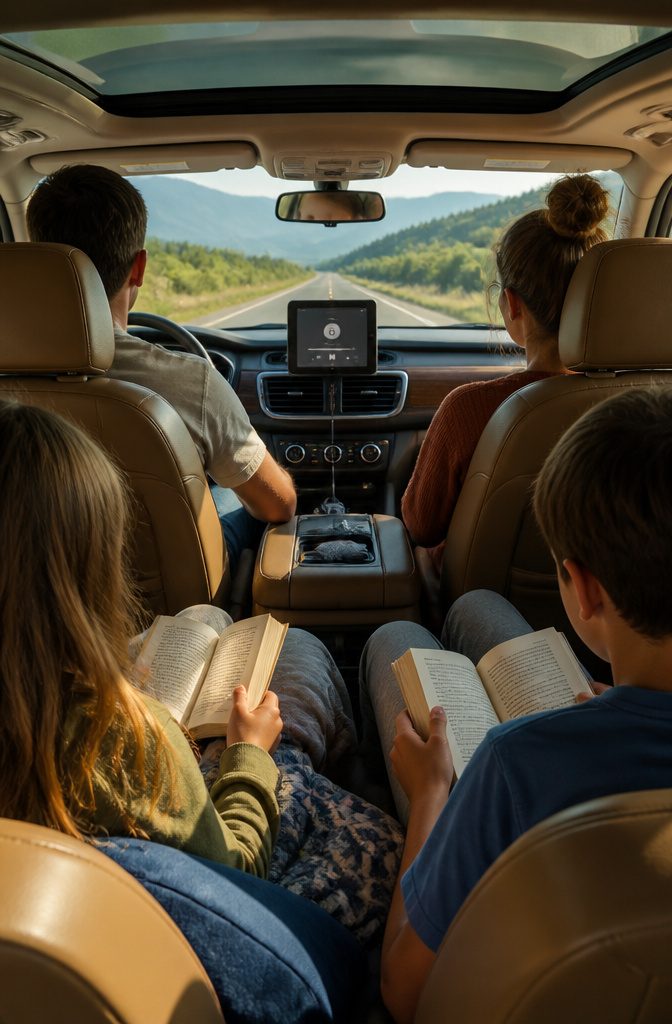
Audiobooks turn the dead hours of a long drive into something the whole car actually looks forward to.
I keep two kinds loaded: something I’ve heard before for when I’m at the wheel, since a familiar plot keeps me alert without the distraction of hanging on every word, and fresh titles for when someone else drives.
The Harry Potter series has survived more trips than I can count without a single "can we turn this off" from the back seat.
The Martian works the same way for older kids and adults, that stranded-on-Mars problem-solving pulling everyone in.
Family-friendly series are the safest bet for mixed ages; a single book that only half the car enjoys turns the trip into a negotiation.
An Audible subscription covers most of what I need, though Amazon Music Unlimited also folds in one audiobook a month if you’re already paying for streaming.
Downloading before you leave matters — mountain highways and rural interstates have a habit of dropping signal exactly when a chapter gets good.

32GB MP3 PLAYER FOR UNDERWATER LISTENING - Enjoy music while swimming without keeping your phone connected. The built-in 32GB MP3 player stores your favorite playlists directly on the W18, making these swimming headphones ideal for lap swimming, pool training and water workouts.

**IMPORTANT - READ THIS! Due to changes to Spotify’s platform, Spotify will no longer be supported on Mighty beginning April 21, 2027.**

**IMPORTANT - READ THIS! Due to changes to Spotify’s platform, Spotify will no longer be supported on Mighty beginning April 21, 2027.**
2. Road Games

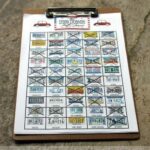
The License Plate Game, Alphabet Game, and I Spy still work because they force everyone in the car to look out the same windows at the same time. That shared focus is what phone-based games kill.
Two ways to run the Alphabet Game: hunt letters in order on any road sign, billboard, or plate you pass, or restrict yourself to road signs only.
The stricter version takes longer and turns "V" and "U" into genuine bottlenecks. Start early in the day when patience is still intact.
For I Spy, one person records sightings out loud while another passenger verifies each one. Or flip it into bingo format: everyone races to fill rows of things spotted from the car.
Either version keeps kids off iPads without feeling like a punishment, and adults in the front seat can play without taking eyes off the road.
A piece of paper or a phone used only for scorekeeping is all the equipment these need. No purchased game set required, though travel-sized Connect 4 or chess exist if you want something tactile for rest stops.

🎵【HiFi Lossless Sound, 45H Battery Life & Wide Format Support】Rediscover every favorite track with rich, detailed audio and a fully customizable EQ—whether you're reliving classic albums or exploring new playlists. Supports MP3, FLAC, WAV, APE, AAC, WMA and more. A full charge takes just 2–3 hours and delivers up to 45 hours of playback—ready for road trips, weekend getaways, and days away from a charger

ALL YOUR MUSIC IN ONE PLACE: Stream with popular preloaded music apps, including Spotify,Pandora, Spotify Kids, TIDAL, and Deezer, or play your own downloaded library offline. This MP3 player with Bluetooth and WiFi is an easy way to enjoy music at home, at the gym, or on the go without draining your phone.
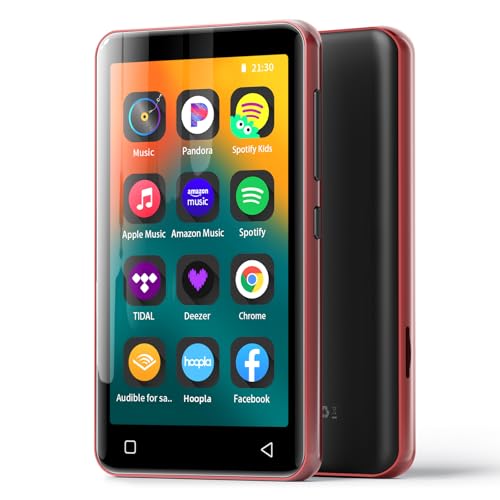
Stream Music Your Way - Enjoy your favorite music wherever you go with this MP3 player with Bluetooth and WiFi. Stream from popular apps including Spotify, Amazon Music, Pandora, Spotify Kids, TIDAL, and Deezer, or switch to offline playback when you want a distraction-free listening experience. A versatile Spotify MP3 player for home, travel, workouts, study, and everyday listening.
3. Music Playlists
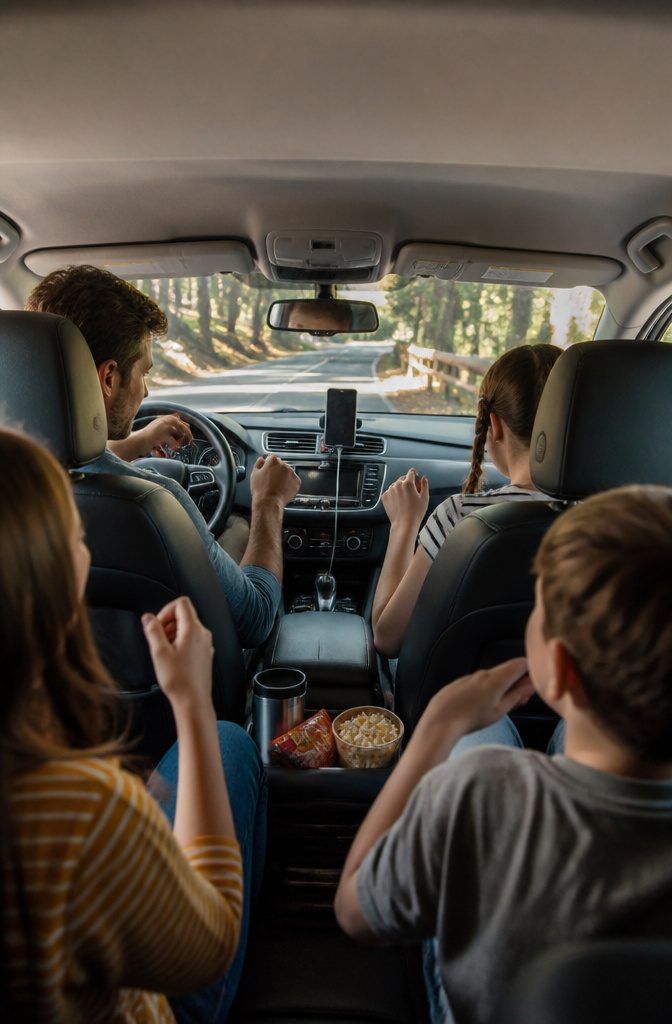
Pre-download every playlist before you leave the driveway. Cell coverage dies on mountain passes and rural interstates exactly when the mood needs a lift, and nothing deflates a car full of singers faster than a buffering icon.
Themed playlists keep energy from flattening over hours. One route: match the music to where you’re headed, stacking songs about the open road or tracks that name your destination.
Another is the hidden-theme game, handing the phone to someone who builds a list around a secret link (every title contains "sun," every cut is from an 80s movie soundtrack) and letting the rest of the car guess the rule.
For families, a names playlist turns the hunt personal, pulling tracks with your kids’ names in the lyrics.
The mix matters more than the theme. Rotate in songs everyone can shout along to; singing out loud keeps the driver awake better than coffee at mile 200.
Ask each passenger for a handful of favorites before the trip and weave them together. What you end up with is a playlist no algorithm would build, full of someone else’s guilty pleasure next to yours.

A fun road trip essential: Combines four exciting travel card games to keep everyone entertained throughout the trip.

FOR THE WHOLE FAMILY: Turn family road trips and moments of in-between time into great family fun. Games on the Go is a collection of 50 games and activities that can be played anywhere at any time.
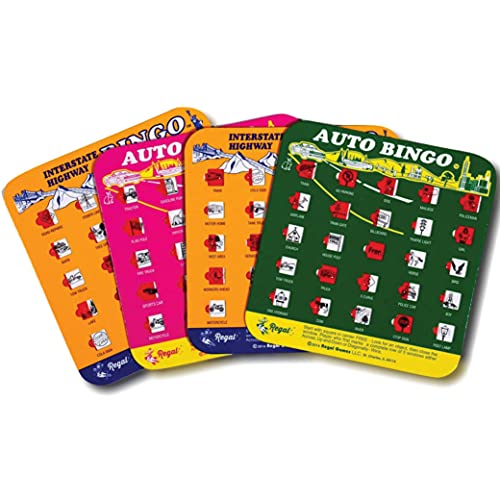
MESS-FREE TRAVEL FUN - Enjoy classic road trip entertainment with finger-tip shutter bingo cards featuring easy-slide windows. No loose chips, markers, or daubers required. Includes Interstate Highway and Auto Bingo games with colorful illustrations that keep kids and adults engaged during long drives.
4. Podcasts
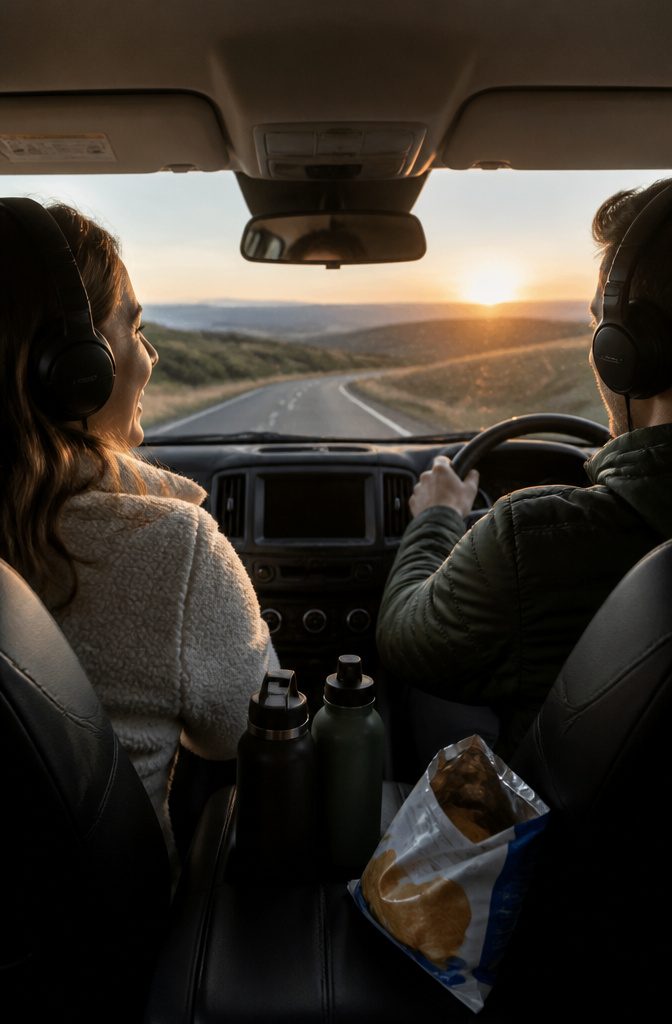
A podcast turns three hours of interstate into something you actually remember. I used to save episodes for car rides specifically, and once burned through a whole true crime series between Denver and Moab without noticing the mileage.
Download everything before you leave; phone signal dies in mountain passes and deserts alike, and streaming eats data fast enough to matter on family plans.
The range of what’s available is the real advantage.
True crime, business, dating advice, blogging tips, comedy sketches that make you snort-laugh in the driver’s seat, there is genuinely a show for whatever you have been meaning to learn about but never find time for at home.
Passengers can take turns picking, which solves the problem of one person’s taste dominating the trip.
If you need your phone for directions, the podcast pauses automatically when the navigation voice cuts in, then resumes after, so you do not miss turns or punchlines.
Families have options too. Kids’ podcasts exist, and they beat handing a child another hour of video on a small screen.

EDUCATIONAL GAME: Interactive US license plate spotting and matching sticker game that makes learning state geography fun and engaging during road trips.
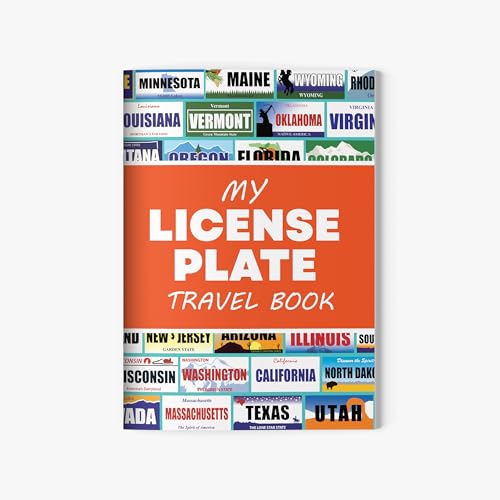
ENDLESS ROAD TRIP ENTERTAINMENT: Turn "Are we there yet?" into hours of fun! This 12-pack of License Plate Game books keeps kids engaged spotting license plates from all 50 US states, making any car ride an exciting adventure.

LICENSE PLATE TRAVEL FUN - Turn every road trip into an exciting challenge with reusable License Plate Bingo cards featuring built-in finger-tip sliding shutters. No chips, markers, or daubers needed. Players search for license plates and travel sights while enjoying interactive, screen-free entertainment for kids and adults.
5. Creative Activities
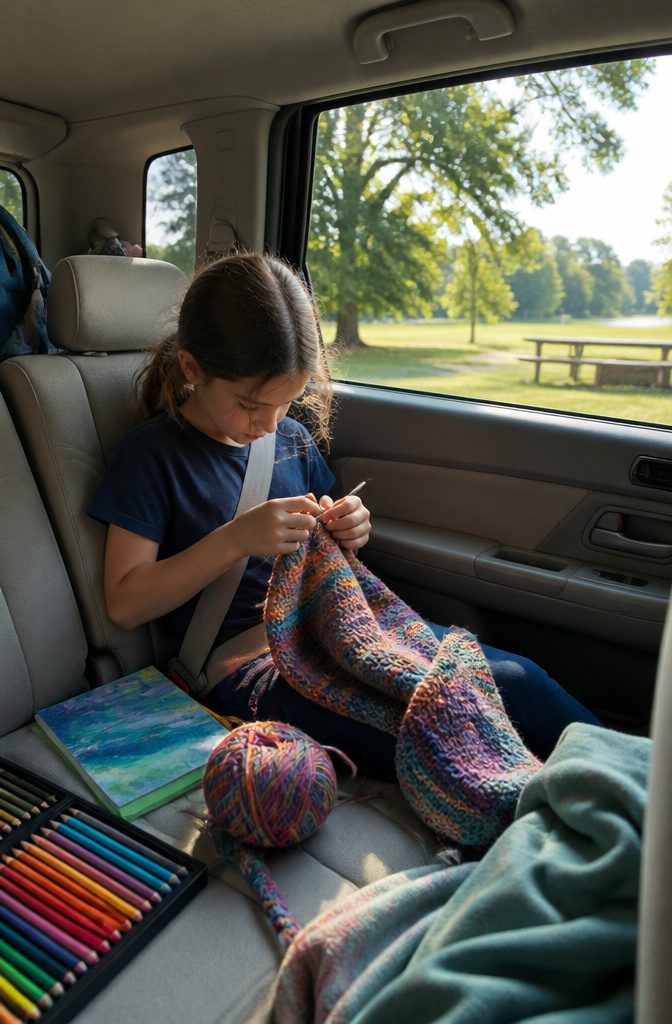
A ball of yarn and two needles turn highway hours into something that actually produces a scarf. Knitting or crochet keeps hands busy and cuts the restless feeling that builds after the first hundred miles.
YouTube has plenty of tutorials if you want to learn; being stuck in a seat with nothing else competing for attention is honestly not a bad classroom.
Coloring works too, though skip the crayons.
One dropped under the seat becomes a melted streak on your upholstery the minute you park in sun. Washable markers or colored pencils hold up better in a moving vehicle.
Let kids pick their own books, mazes, or workbooks, and you buy yourself stretches of quiet while they stay occupied with something that uses fine motor skills instead of a screen.

Educational Gameplay: Based on the popular I Spy books, this game enhances observation skills and cognitive development, encouraging children to think critically and pay attention to detail.


Classic Memory Game: Combines the beloved I SPY theme with the classic memory matching game, making it familiar and engaging for young players.
6. Trivia Games
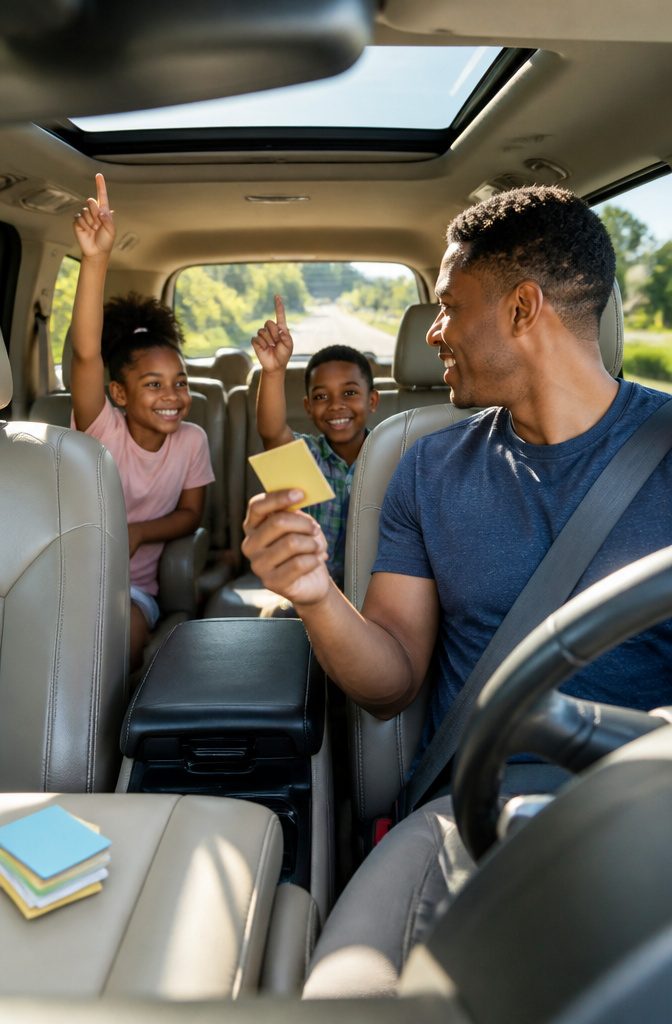
Trivia turns a car full of mixed ages into a single team faster than anything else I’ve found. The trick is matching the deck to the weakest player so nobody checks out.
Professor Noggin cards handle this with printed difficulty levels on each question, which means a third grader can stay in the same round as a grandparent without either one feeling patronized or lost.
The topics run deep enough that most families will find a deck that sticks, US History, Space, Science, Wildlife, Geography, and the birding crowd has Sibley’s own set if that is your household’s particular obsession.
For families where nobody wants to feel tested, flip the format and let the kids ask questions they already know the answers to.
It sounds backwards, but giving a ten-year-old the job of stumping the car with state capitals or dinosaur facts keeps the energy up and the shame factor at zero.
Sugar-free hard Lifesavers as prizes help; the reward matters more than the candy itself.
Movie trivia works on a different circuit entirely.
Disney quotes in particular draw in teenagers who would roll their eyes at anything academic, and the quotes layer well with a phone search to pull up the actual scene or song as proof.
Star Wars fact sets and superhero rounds fill the same niche for households where that is the shared language instead.


**IMPORTANT - READ THIS! Due to changes to Spotify’s platform, Spotify will no longer be supported on Mighty beginning April 21, 2027.**

**IMPORTANT - READ THIS! Due to changes to Spotify’s platform, Spotify will no longer be supported on Mighty beginning April 21, 2027.**
7. Writing Activities
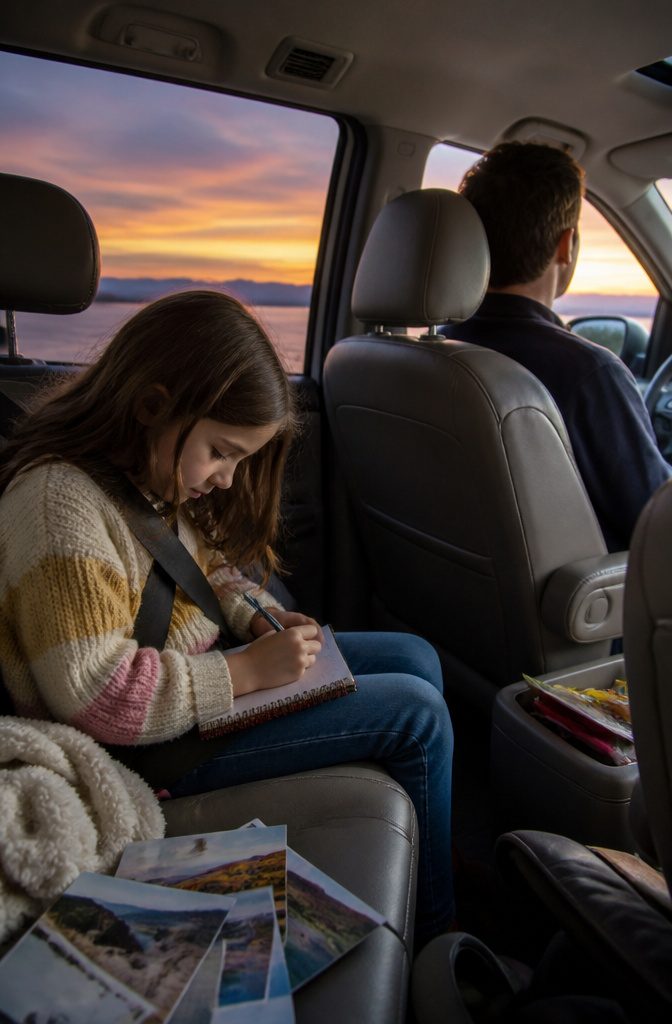
A small notebook tucked in the glove compartment turns idle miles into something you keep. Each trip, someone reads aloud the last entry, then adds the date, destination, and mileage for the current ride.
Kids who can write take turns recording what they notice; for the driver, another passenger acts as scribe. The entries stack up over years: a funny quote, a weird roadside sign, the exact mile marker where the tire blew.
Passengers only, obviously — but that constraint is part of the point. The driver stays locked to the road while everyone else gets to shape what the trip means.
Letters work the same way. A passenger drafts a note to a grandparent or a friend, something that will actually arrive in a mailbox days later.
Picking out a postcard at a stop and writing it before the next town gives the message a sense of place that a text never carries.
The handwriting, the stamp, the lag between sending and receiving — these are the features, not bugs. Both the journal and the letter turn the car from a container of boredom into a room where something gets made.
Stream Music Your Way - Enjoy your favorite music wherever you go with this MP3 player with Bluetooth and WiFi. Stream from popular apps including Spotify, Amazon Music, Pandora, Spotify Kids, TIDAL, and Deezer, or switch to offline playback when you want a distraction-free listening experience. A versatile Spotify MP3 player for home, travel, workouts, study, and everyday listening.

ALL YOUR MUSIC IN ONE PLACE: Stream with popular preloaded music apps, including Spotify,Pandora, Spotify Kids, TIDAL, and Deezer, or play your own downloaded library offline. This MP3 player with Bluetooth and WiFi is an easy way to enjoy music at home, at the gym, or on the go without draining your phone.

ALL YOUR MUSIC IN ONE PLACE: Stream with popular preloaded music apps, including Spotify,Pandora, Spotify Kids, TIDAL, and Deezer, or play your own downloaded library offline. This MP3 player with Bluetooth and WiFi is an easy way to enjoy music at home, at the gym, or on the go without draining your phone.
8. Snacks and Eating
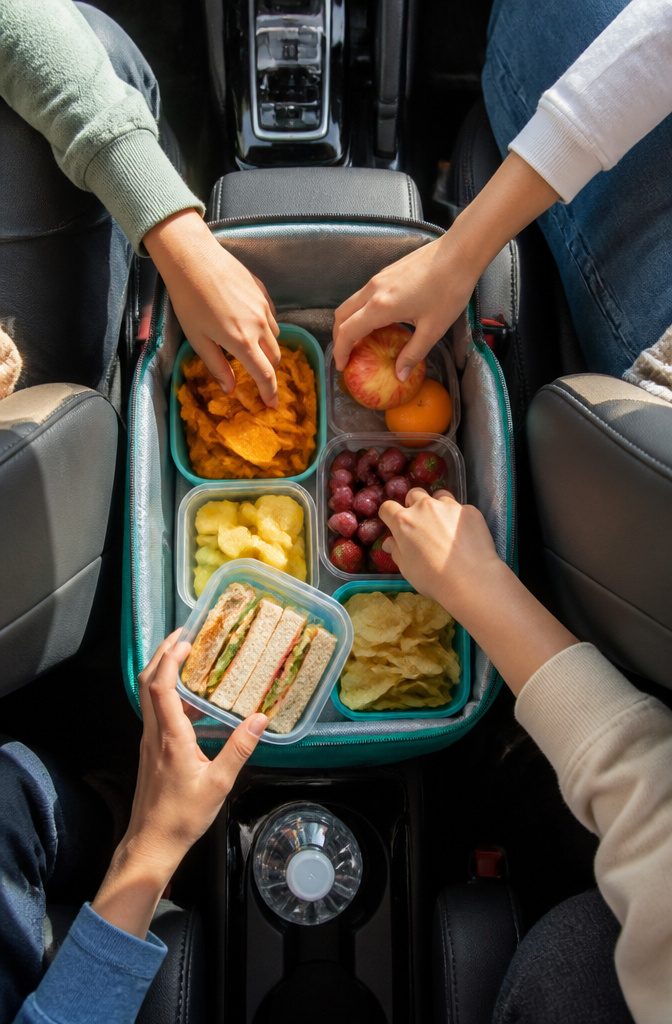
A cooler bag wedged behind the passenger seat, stocked with both fruit and chips, turns the stretch between gas stations from endurance test into something you actually look forward to.
The trick is timing the snacks to the map, not the appetite.
I parcel out the fun stuff, the treats I rarely buy at home, for the hour when the highway starts looking the same and the backseat goes quiet. That wave of restlessness hits differently with something salty in hand.
Save the heavier, more filling options for later, when a real slump sets in and the next stop is still an hour out. A hangry driver, or a hangry passenger directing the driver, can unravel a whole afternoon.
The small planning step of packing little containers beats buying at every pit stop, and the money not spent on gas station markup is its own small win.

🚗 Engaging Conversations: Features 100 thought-provoking questions to spark meaningful discussions during your travels.

🔎 Are you a parent looking for a fun and exciting way to keep your kids entertained during your next road trip? Look no further than Road Trip Scavenger Hunt!

Looking for an exciting way to make long drives fly by with your partner or friends? Look no further than Highway Showdown, the road trip trivia game that sparks laughter and friendly competition from the first mile.
9. Interactive Games
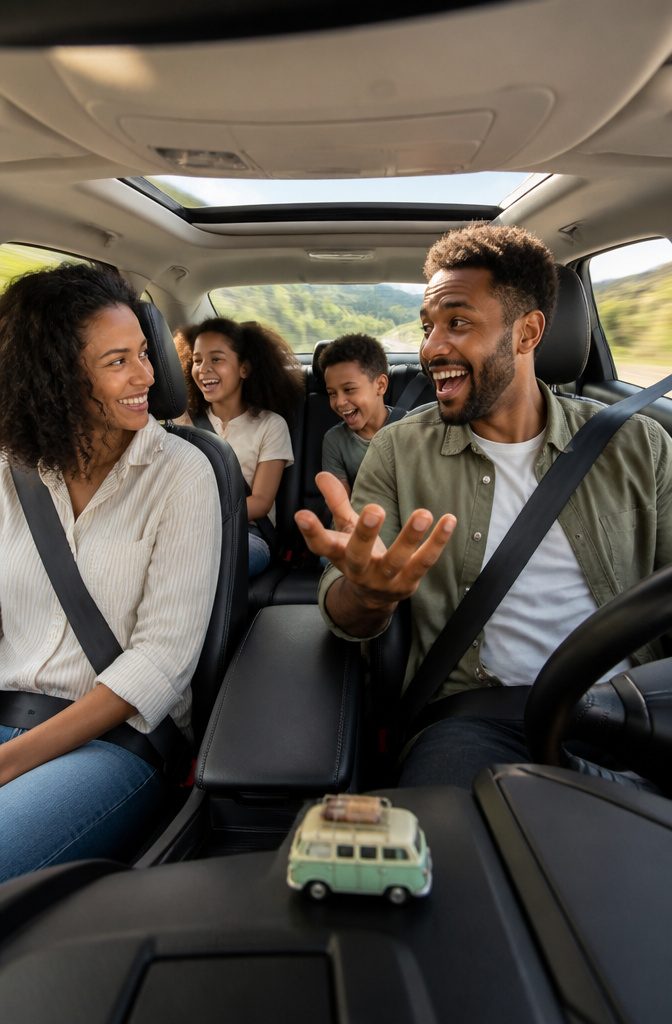
Some of the best moments in a car happen when someone asks whether you’d rather eat nothing but pickles for a year or wear wet socks every day.
Would You Rather works because the questions get deliberately ridiculous, which breaks the stiffness out of any group fast.
No cards, no app, no scorekeeping. One person poses two options, everyone picks and defends their choice, and the arguments are usually funnier than the prompt.
Twenty Questions runs the same way. One passenger thinks of something, anything, and the rest take turns asking yes-or-no questions until they hit twenty or guess it.
The game scales to any age. A six-year-old guessing "triceratops" and a grandparent narrowing in on "the Eiffel Tower" are playing the exact same rules.
Both games need nothing but voices. That matters on a long drive when devices die, bags are buried in the trunk, or the back seat has already gone through every snack.
The questions themselves can be prepared ahead or invented on the spot. Sources suggest keeping a printed set in the glove box if you want ready-made prompts, but pulling something awful from your own imagination tends to land better.


ENDLESS FUN: This car bingo game features over 200 unique items 9 themes to spot on the road like trucks, signs and landmarks to keep kids entertained for hours. You can also customize your own with 2 blank bingo cards.

10. Stop at Attractions

The only thing that gets everyone out of the car is the stop itself, so make the stop worth the lost momentum.
Museums, amusement parks, or the kind of kitschy landmark that exists mainly to give you something to photograph: the world’s biggest ball of twine, a house shaped like a shoe.
These breaks do two jobs at once. They stretch legs that have been folded into backseats for hours, and they give the trip a shape beyond point A to point B.
Planning matters more than spontaneity here. Roadside America and Atlas Obscura both catalog the oddities that sit just off the interstate, often in towns you would otherwise blow past.
I have learned to look these up the night before, not because I love itineraries, but because a passenger googling "weird stuff near me" from a moving car usually returns either nothing or a closed-down attraction sixty miles behind us.
If the drive runs longer than a single day, book the overnight hotel before you leave.
Prices climb the closer you get to needing the room, and the energy you saved by not driving straight through disappears fast when you are hunting lodging at ten o’clock in a town with two options.


Educational and Fun: This game is based on the popular I Spy books, combining education and entertainment to engage young minds.

Learning a Language
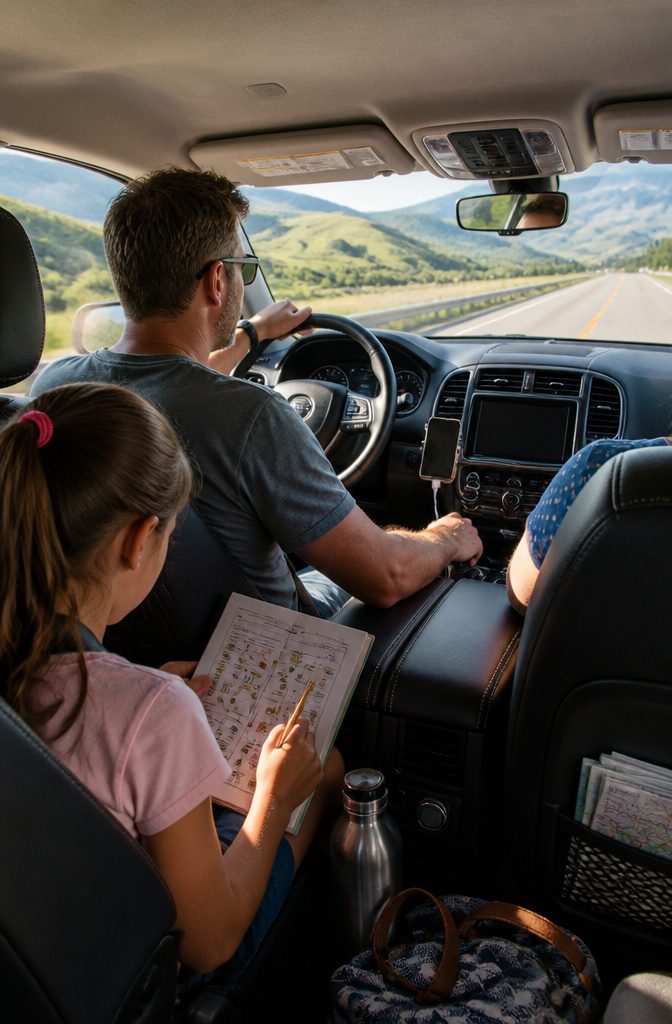
Drive time is dead time for most passengers, which makes it the right moment to pick up a language you have always meant to learn.
Audio-only courses work best here, since the driver can participate without taking eyes off the road. Apps with speaking drills are better left to passengers; the driver gets enough mental load already.
A long enough stretch of highway can move you from tourist phrases into actual conversation.
The progress feels slow at first, but fifteen hours behind the wheel adds up to real hours of practice you would not have found at home.
If your destination has its own local language, starting on the road means you land with more than the usual tourist vocabulary. The payoff is practical, not just the fun of the work itself.
Selfie Scavenger Hunt

A scavenger hunt works better on road trips when every item demands a selfie with it. The phone is already in every passenger’s hand, so the game turns that distraction into the point.
Before leaving, one person builds the list: a horse in a field, a sign for pie, a rusted tractor, a water tower painted with a town name.
The photo proves the find, and the photographer has to be in the frame too, which makes the composition harder than a quick window shot.
Two ways to run the scoring. Everyone plays solo and races to check items off first, which keeps a car of adults competitive.
Or the whole car collaborates on every photo, all five people squeezed into the frame at each stop, which slows the game down and usually produces the pictures people actually keep.
The second format came from a family trip where the father insisted on it; the group shots outlasted every individual post.
The list should require interacting with strangers for at least one item. Ask someone at a rest stop to take the group photo, or get a truck driver to laugh on camera before the selfie.
These are the frames that break the highway monotony and the ones that earn the most likes if anyone posts them later.
Meditation on Breaks
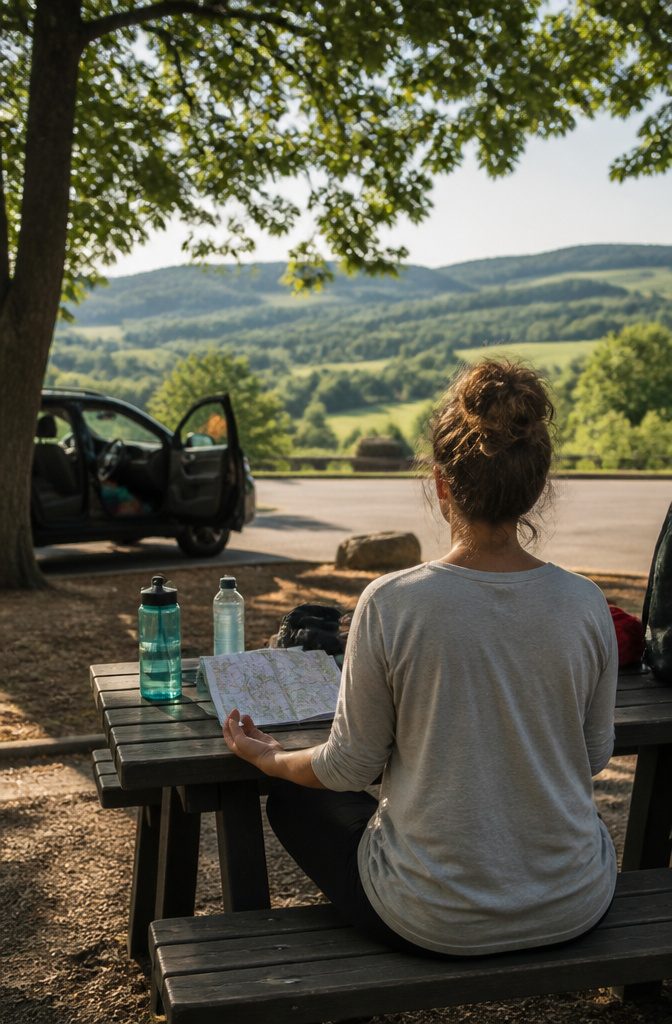
A rest stop with the engine off is the only place this works.
The car is still warm, the seat still holds your shape, and for five or ten minutes you can sit with eyes closed and let the road noise fade.
I have tried the apps that guide you through breath counts, but on long drives I prefer the simpler move: three slow inhales through the nose, held for a four-count, released through the mouth.
The trick is setting a timer so you do not drift into sleep, especially after lunch when the body wants it. Standing to stretch first helps; blood in the legs keeps the mind alert enough to stay with the breath.
I do this every three hours on a full-day drive, and it resets the irritation that builds at mile two hundred far better than scrolling my phone ever did.
Frequently Asked Questions
What are some fun things to do on long car rides?
Audiobooks, road games, music playlists, podcasts, creative activities, trivia, writing projects, interactive games, and planned stops all keep a car full of people engaged across hundreds of miles.
The key is mixing formats so no single activity burns out, and having everything downloaded or packed before you leave since cell coverage disappears exactly when you need it.
What are some fun road trip games?
The License Plate Game, Alphabet Game, I Spy, Twenty Questions, and Would You Rather all work without any equipment beyond maybe paper for scorekeeping.
The Alphabet Game has two difficulty levels, hunting letters on any sign or restricting yourself to road signs only, and I Spy can shift into bingo format where everyone races to spot items from a printed grid.
What audiobooks are good for road trips?
The Harry Potter series and The Martian have both survived multiple long trips without anyone asking to turn them off, and family-friendly series in general are the safest bet when ages are mixed.
Keep two kinds loaded, familiar titles for the driver since known plots keep you alert without demanding full attention, and fresh books for when someone else is at the wheel.
How can I keep kids entertained on long car rides?
Road games that force everyone to look out the same windows, coloring books with washable markers instead of crayons, trivia decks with difficulty levels printed on each card, and letting kids ask questions they already know the answers to all keep children occupied without feeling like punishment.
Snacks timed to the map rather than appetite also help, especially when the fun treats come out during the hour the highway starts looking the same.