A packing list is only useful if it accounts for the bag you actually own and the trip you are actually taking.
The same six clothing items can yield sixteen outfits when the colors coordinate, but that math collapses if you fold instead of roll.
The 3.4-ounce TSA limit on liquids, not the brand you prefer, is what determines whether your toiletry kit clears security.
Clothing
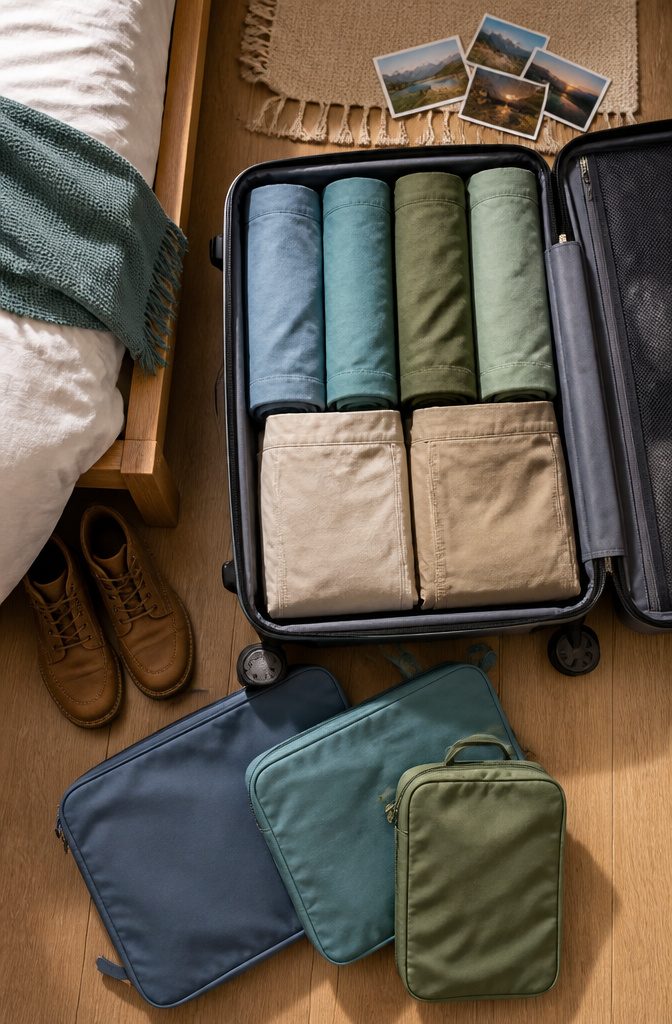
Tops and bottoms work harder when they share a color story. Two neutral pants and four tops that all play together give me sixteen combinations from six pieces, which is the math that keeps a carry-on honest.
A quick-dry merino layer does double duty as sleep shirt and hiking base layer, and that versatility matters more than the exact day count on the itinerary.
Rolling beats folding for the space it opens up, especially with thinner items like tees and light sweaters.
Compression packing cubes then squeeze those rolls into bricks you can sort by activity, outfit, or clean versus dirty. The mesh laundry bag keeps the separation going once you’re there.
Bulky items worn onto the plane, never packed inside it.
That rain shell, those heavier boots, the one thick sweater. The jacket comes off at your seat and stuffs overhead; the boots stay on and free up the quarter of a carry-on they would have eaten.
Footwear is where most of us overpack.
One pair that walks all day, one that dresses up enough for dinner, and sandals only if water or beach is definite. Undergarments scale directly with trip length, with one spare day built in for the travel itself.

【Selected High Quality Materials】The compression packing cube set is made of 210D Nylon three-part fabric and 100mm see through mesh , Soft and lightweight, Tear-resistant and extensible. With plated smooth zipper. High-end zipper head, Easy to stretch and very durable.

5-PIECE TRAVEL CUBE SET, EXACT SIZES: 4 suitcase packing cubes for travel — Extra Large (17.5"×12.75"), Large (13.75"×12.75"), Medium (13.75"×9.75"), Small (11"×6.75") — plus a Laundry Bag (20.5"×15.75"). All cubes are 4" deep and sized to cover every clothing category for women and men. Fits standard carry-on and full-size checked luggage.
Toiletries
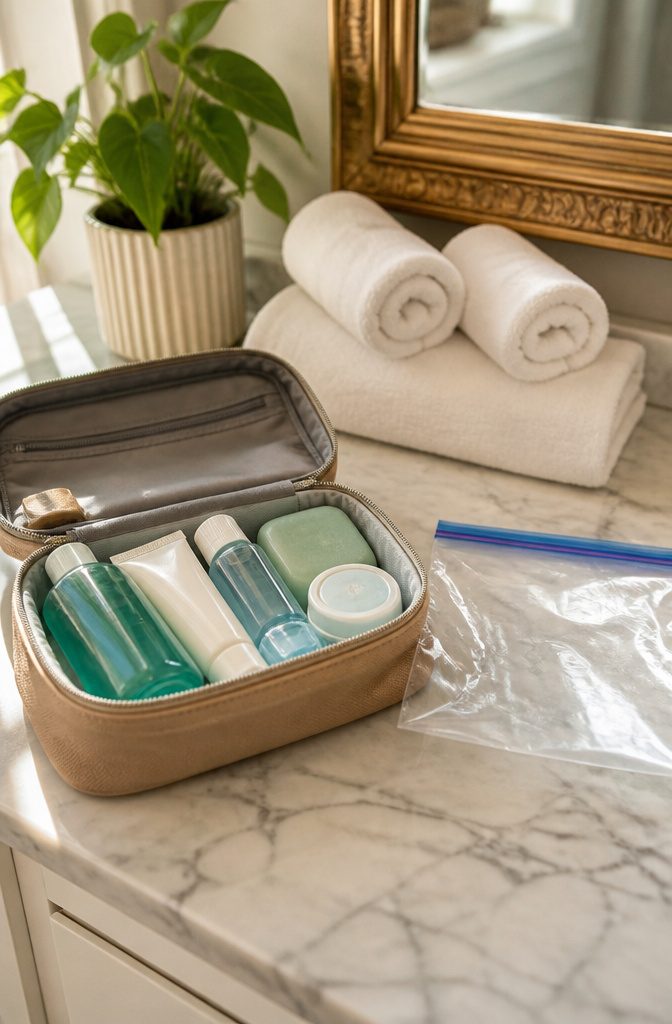
Toothpaste, shampoo, and body wash are the core of any toiletry kit, but the container size matters more than the brand.
The TSA caps every liquid, gel, aerosol, cream, and paste at 3.4 oz or 100 ml, and all of them have to fit in one quart-sized clear bag if you’re carrying on.
That rule includes mouthwash, lotion, and makeup remover, so the math gets tight fast. I move everything into travel-sized bottles and skip the full-size versions entirely, even in checked bags, because the space savings are worth it.
A small first-aid kit lives in my bag no matter the destination.
Band-Aids, pain relievers like Tylenol or Advil, and antiseptic cream cover the incidents that actually happen: blisters from new shoes, a scraped knee on cobblestones, a headache after a long flight.
Sources disagree on where to stow medication. One camp says checked luggage to avoid the 3-1-1 hassle; the other says carry-on, because you might need it mid-flight or on a layover.
My read: anything you take daily belongs in your personal item, period. Backup supplies and first-aid extras can go below.
What you can replace at your hotel is shorter than you’d think.
A front desk will usually hand over a spare toothbrush, razor, or shower cap. Prescription medication, contact lens solution, and your preferred skincare products are harder to source on arrival, so those travel with you every time.

【TSA Approved】The 7.7 x 5.9 x 2.5 inch clear toiletry bag strictly follow 3-1-1 liquids rule for carry-on bag of all airlines, so you can easily and quickly pass through airport security.
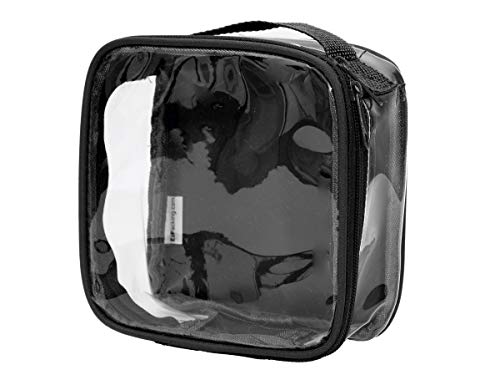
EASY COMPAR ENTALIZATION: Use the bags to create a completely customizable organization system; Buy multiple bags and color coordinate to easily compartmentalize and organize a hand bag, tote bag, purse, diaper bag or gym bag

𝟏𝟖𝟎° 𝐎𝐩𝐞𝐧𝐧𝐢𝐧𝐠 𝐃𝐞𝐬𝐢𝐠𝐧: TSA approved toiletry bag can open up to 180°, enabling the clear bag to be easily flipped open horizontally, providing convenient access to travel essentials. The durable handle design allows for easy lifting and hanging of this clear bag.
Electronics
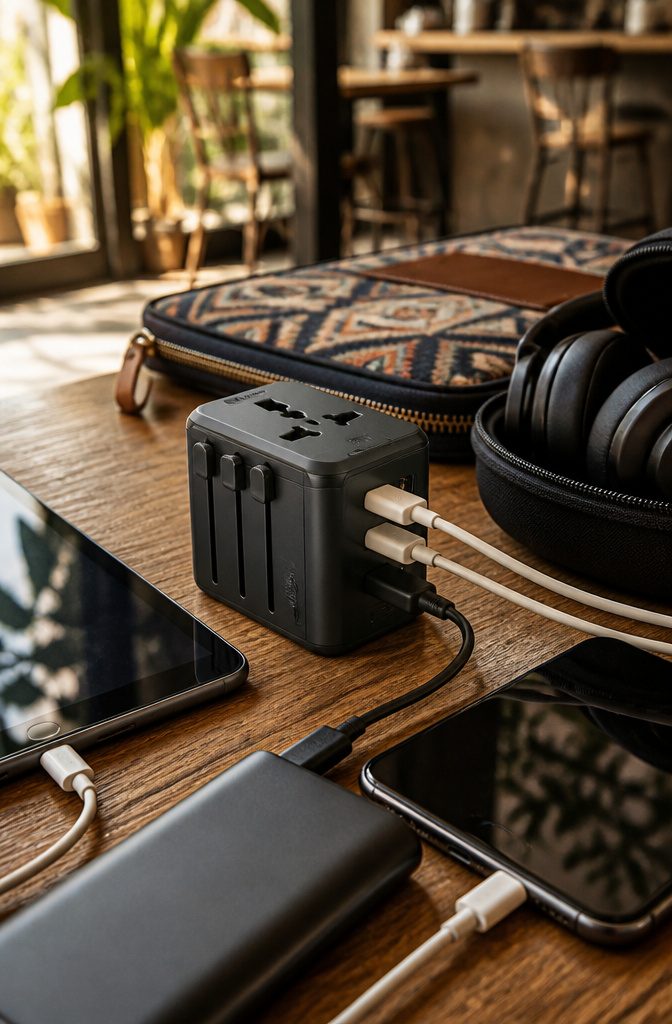
Outlet types change country to country, so a universal travel adapter is the first thing to check off.
The Tessan models handle multiple plug standards and let you charge several devices from one hotel outlet, which matters when your phone, laptop, and power bank all need juice before morning.
One adapter with multiple ports beats carrying separate charging bricks for each device.
Your phone and its charger stay with you, period.
It is your navigation, camera, and safety net abroad. An eSIM through Holafly or Airalo keeps you connected without hunting down local SIM cards.
A portable power bank sits right next to it in your bag. Dead phone mid-day means dead maps, dead translations, dead ride-shares.
Headphones need two solutions. Noise-canceling pairs handle the flight itself, but corded headphones or a Bluetooth transmitter like AirFly connect to in-flight entertainment systems that still expect a headphone jack.
What stays home?
The laptop unless work demands it. The tablet unless you read enough to justify the weight against your phone screen.
Leave the camera if your phone handles your photo needs. Chargers for devices you left behind are just dead weight.

SOFT LYOCELL BLEND FABRIC — This 2-pack wool blend shirt women made of 75% lyocell, 18% merino wool and 7% elastane, so it feels smooth against skin instead of scratchy. Cut as a fitted base layer, it wears solo in warm weather or as a mid-layer when temps drop.

MERINO WOOL BLEND — Made with 80% merino wool and 20% nylon for breathable comfort, added durability and better shape retention.

MERINO WOOL COMFORT: Crafted from superfine merino wool, this women’s tank top delivers gentle, irritation-free wear all day. Its lightweight, flexible fit makes it perfect for lounging at home, long workdays, or casual outings.
Travel Documents
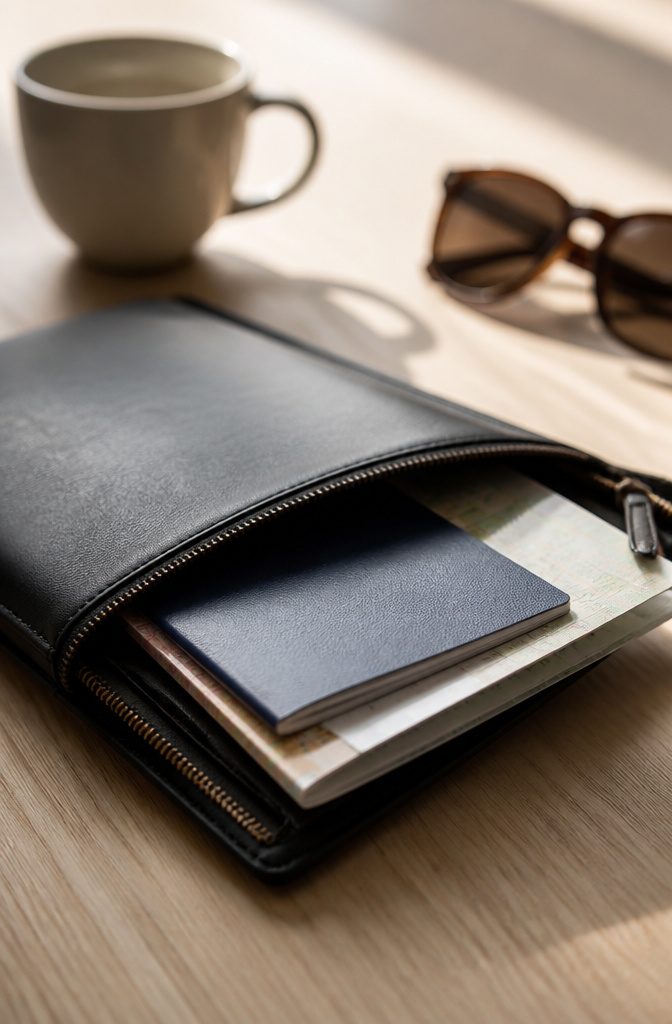
Passports need at least six months of validity left for many destinations, a detail that has bailed me out more than once after nearly showing up with four months to go.
I keep the physical copy in a slim document wallet and scan every page to my phone before I leave the house.
The scan lives in a cloud folder I can reach from any device, plus I email a second copy to a family member who stays home.
Travel insurance paperwork, especially policy numbers and the 24-hour claims line, goes in the same wallet.
I learned to carry the actual card or printout after assuming my phone would suffice and then watching the battery die mid-conversation with a clinic in Lisbon.
Hotel confirmations and full itineraries, with addresses written out for taxi drivers, fill the remaining slots.
Emergency contacts need two forms: a written card in the wallet, because phones lock, and the same numbers saved in the cloud folder.
Driver’s licenses and backup debit cards round out the set. Some travelers add vaccination records; I only pack them when a country still asks at the border, which matters less now than it did in 2022 but still happens.
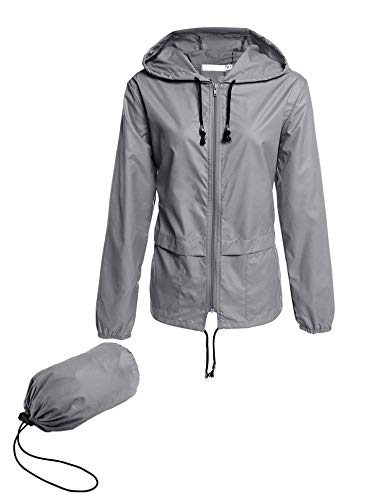
WATER-RESISTANT & LIGHTWEIGHT – Crafted from water-resistant fabric, this women's rain jacket helps keep you comfortable during light rain and windy days. Lightweight, breathable, and soft against the skin, it offers all-day comfort.

【Waterproof & Breathable】Rain jacket for men is made of high density soft shell fabric, high quality waterproof coating inside. Fully sealed seams further improve waterproof performance, advanced technology enhanced breathability that keep you cool and dry all day.

High quality special waterproof and windproof fabric offers a breathable and comfortable wear experience in any kinds of weather condition
Miscellaneous
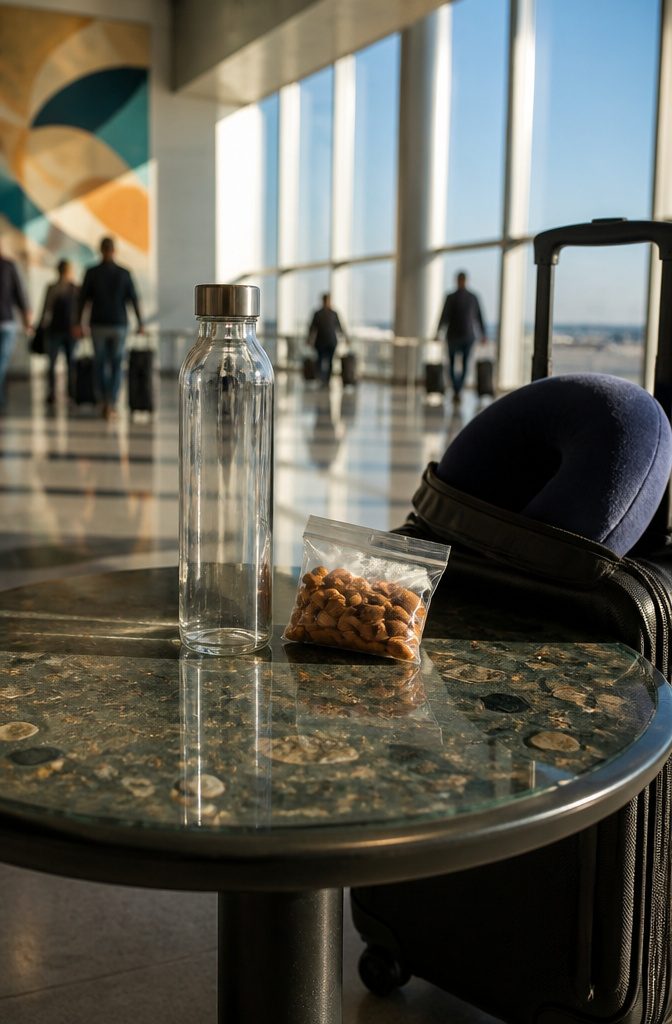
The line between a carry-on that helps and one that punishes you shows up fast at the security gate.
An empty reusable water bottle earns its place every time: fill it past TSA and you skip the $5 airport markup, and on a long day of connections the savings add up.
Snacks do the same work. A small bag of almonds or a protein bar bridges a missed meal without the terminal price tag, though anything crumbly or pungent turns your seat neighbor into an enemy for the next three hours.
Comfort items split cleanly between transit and arrival. A travel pillow, eye mask, and earplugs address the specific misery of a plane cabin: dry air, random light, the chatty passenger in 14C.
These do nothing for you at a beach hotel, so they stay in the bag once you land.
The same goes for a light scarf or travel blanket, which replaces the questionably clean airline version without adding bulk a jacket wouldn’t already cover.
In case you’re separated from your checked bag or other items, you should always make sure that you have your ID, wallet, house keys, medications, valuables, camera, phone, laptop, tablet, pen, cash and cards, glasses, and copy of your itinerary with you on the plane.
What this means in practice: the things that keep your trip alive if your luggage takes a different vacation belong on your body, not in the hold. Everything else is negotiable.
A deck of cards or a paperback passes a delay, but weighs against the same space a change of clothes would occupy if your bag goes missing. Dead weight is anything you pack for a hypothetical moment and never unwrap.

✅Travel First Aid Pack, Box of 12: Includes 12 portable, travel-size mini first aid packs. Ideal for everyday carry, travel, and outdoor use.

Be prepared for anything: BAND-AID Brand Travel Ready First Aid Kit delivers an assortment of 80 pieces of first aid essentials to provide pain relief, wound care, and protection for all your minor cuts, scrapes, burns, aches, and pain

The first aid kit is small, portable and includes 20-pieces, making it perfect for your car, travel, bookbag, carry-on luggage, desk drawer, handbag, and more!
Special Items
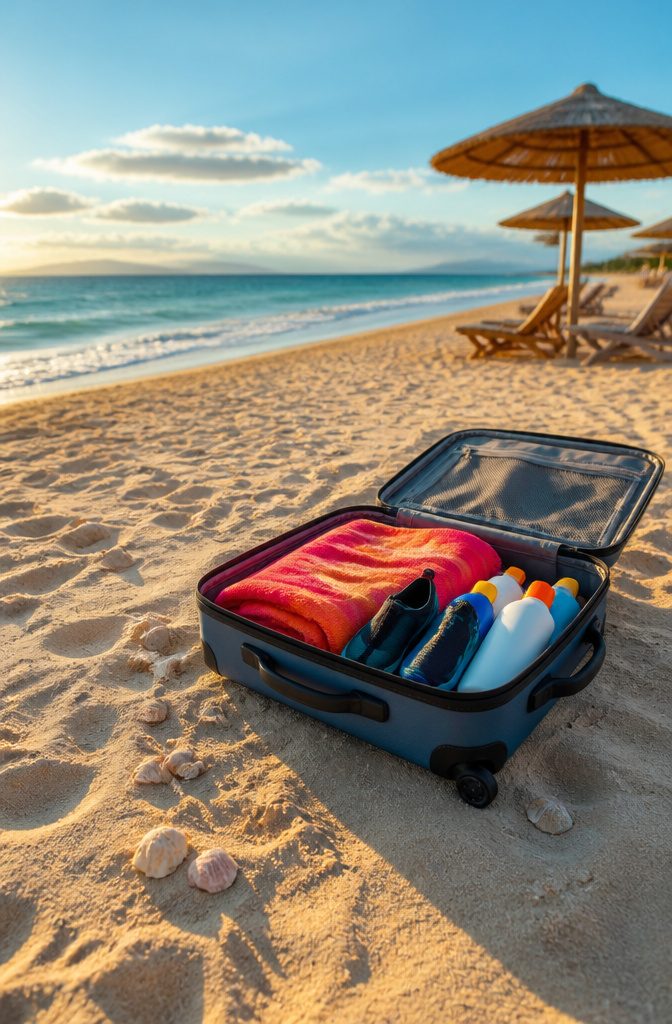
Beach trips sink or swim on what you remembered to throw in the bag.
Water shoes, a quick-dry towel, and solid sunscreen are the non-negotiables; snorkel gear sits in the maybe column because most decent beach towns rent it by the half-day for less than you’d pay to check a bag.
Rent what you can, pack what you can’t replace is the rule I keep coming back to.
Hiking boots are the opposite problem. A rental pair that hasn’t molded to your foot turns a five-mile loop into a blister audit, so these come with me even when they eat half the carry-on.
Quick-drying clothing and a day pack that can handle both trail and town round out the load.
The real mistake is packing for "a beach trip" or "a hiking trip" in the abstract.
A Caribbean island in July needs different coverage than the same island in January, and a desert trail at elevation will punish the same boots that felt fine at sea level.
I spend an embarrassing amount of time scrolling location tags on Instagram and Pinterest before I commit to gear, because someone standing where I’m headed in the month I’m going tells me more than any generic list.
The formal wear and dress shoes for a cruise, the neck gaiter for a ski trip, the long-sleeved layers for Middle Eastern sun: these only make the cut once I know the exact place and the exact week.

How to Compress:The cube is compressed by the middle zipper; Using steps: 1)Fold and flatten clothes 2)Pack clothes in the cube and zip the front zipper 3) Put a finger on the back of the middle zipper when compressing to avoid zipper get stuck in fabric

TAILORED FOR CARRY-ONS: This 7-piece compression packing cube set is specifically engineered to fit the interior dimensions of standard 20" and 22" carry-on suitcases without wasting an inch of space.

6 Set Compression Packing Cubes - If you'll be preparing multiple outfit options for your travel, you no longer have to sacrifice style for luggage space when you come across BAGSMART PACKING CUBES. Large for jackets, sweaters, and trousers, Medium for shirts, and blouses, Small for underwear, drawstring can be used as a laundry bag to separate your dirty/wet clothes or shoes.
Packing Strategies
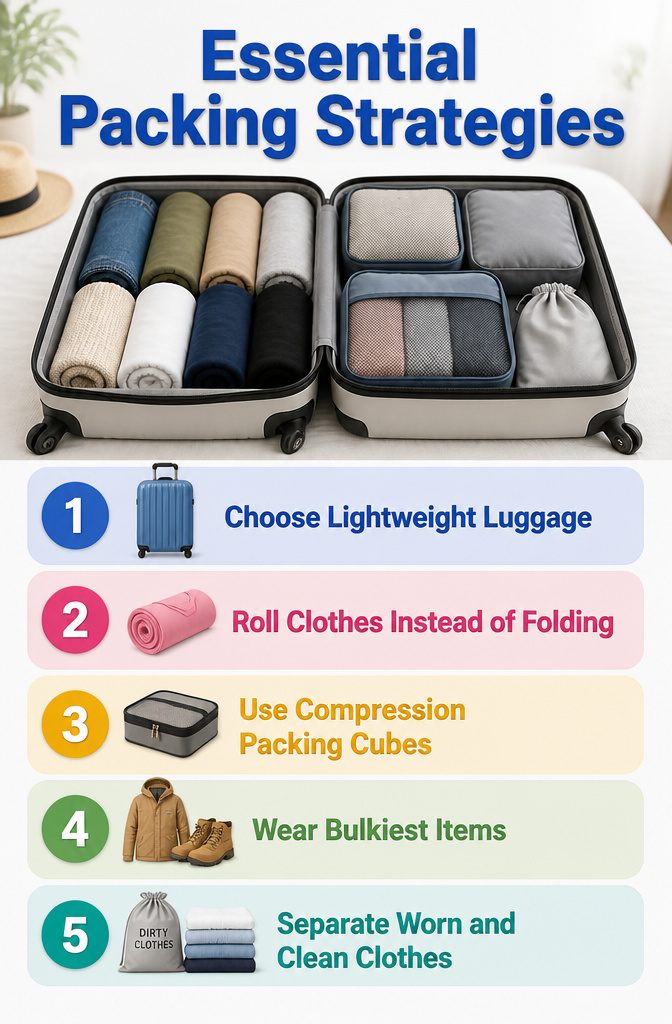
Packing light starts with the bag itself. A carry-on-sized piece of lightweight luggage keeps you out of checked-bag fees and saves the wait at the carousel.
I used to pack for every scenario until a rain jacket spent ten days crushed at the bottom of a suitcase in Sicily, untouched.
Rolling clothes instead of folding is what actually creates usable space, especially for tops and smaller items.
The trick is placing heavier pieces like jeans on the bottom and lighter rolls on top so weight distributes evenly. Compression packing cubes then finish the job.
I sort mine by event now, not by clothing type: one cube for going-out outfits, another for pajamas and workout wear. Finding what I need takes seconds instead of unpacking half the bag in a hotel hallway.
Wearing the bulkiest items during travel, the boots and the jacket, leaves room inside for what you will actually change into.
I stopped carrying travel-sized laundry detergent after realizing most places I stay have a sink and any bar soap works fine.
A lightweight bag for dirty clothes still comes, though. Separating worn and clean pieces keeps the system from collapsing by day four.

【TSA Approved for Stress-Free Travel】: This travel toiletry bag meets TSA 3-1-1 liquid rules with quart-size dimensions (7.7" x 5.9" x 2.8"), helping you pass airport security quickly and easily.

Compliant with Airport Security Approved:The travel toiletry bags can help you go through airport security quickly. The size about 20x20cm / 1 Litre, meets EU & CAA & TSA airport security requirements for carry-on liquid bags,quart size travel bag tsa approved

TSA Approved: TSA-approved toiletry bags strictly follow 3-1-1 regulations and 100% work internationally. All-round transparent design can help to pass through airport security quickly and save time.
Travel Safety
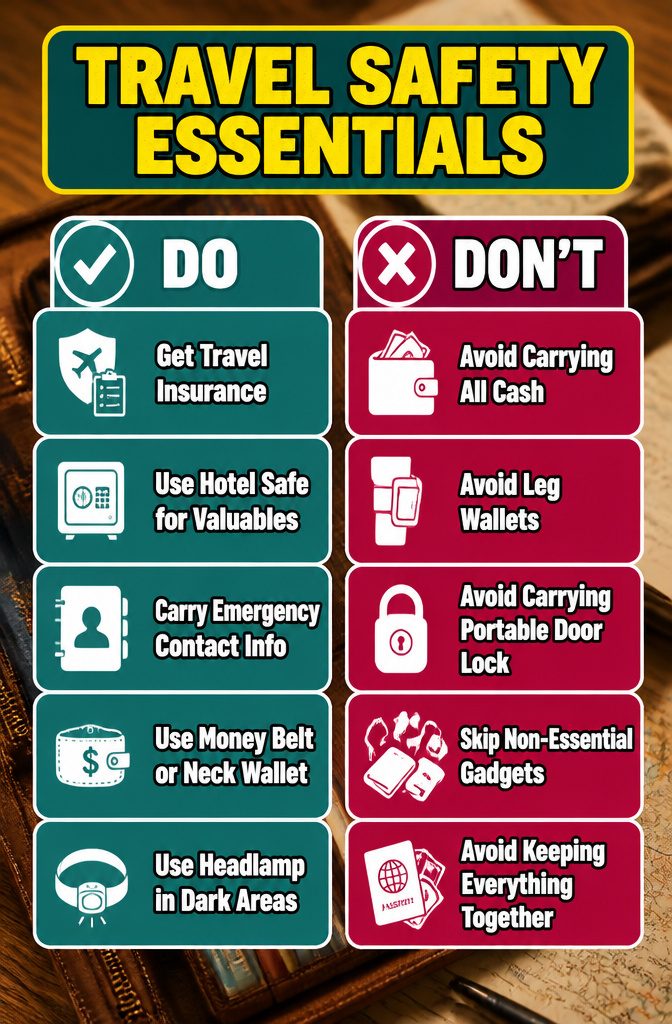
Travel insurance lands in my pack because a stolen wallet in Lisbon taught me what the policy actually does.
The coverage I carry now reimburses medical emergencies, trip cancellations, and lost luggage, but the fine print on cash theft capped my claim at $500, leaving me short for the train fare home.
That policy sits in my bag alongside photocopies of my passport and a list of emergency contacts, including my bank’s international number, because Wi-Fi fails when you need it most.
For valuables, the hotel safe holds my actual passport, backup credit card, and the bulk of my cash. What travels on me is different: a money belt under my shirt carries one day’s cash and my primary debit card.
A neck wallet works too, though I found the straps chafe on long walking days. The leg wallet option exists for tighter clothes, but I have never bothered.
What stays out of either is anything I cannot afford to lose all at once; the belt is for access, not storage, and spreading the risk matters more than any single gadget.
A portable door lock adds weight I sometimes skip, but in ground-floor rooms or hostels with flaky latches, it earns its place.
The same goes for a headlamp: not for glamour, but for finding keyholes in unlit entries or reading insurance forms when the power cuts out.
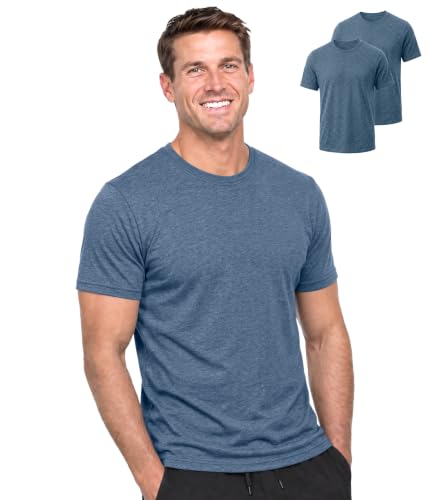
SOFT AND ITCH FREE: 75% Lyocell, 18% Merino Wool and 7% Spandex knit smooth against skin, with a tagless collar that stays flat. Two shirts in every pack

MERINO WOOL COMFORT: Crafted from superfine merino wool, this women’s tank top delivers gentle, irritation-free wear all day. Its lightweight, flexible fit makes it perfect for lounging at home, long workdays, or casual outings.

Merino Wool Hiking Socks included: Package includes Merino Wool Thermal Top Men Lightweight and Merino Wool Hiking Socks. Makes a Great Gift!
Health Considerations
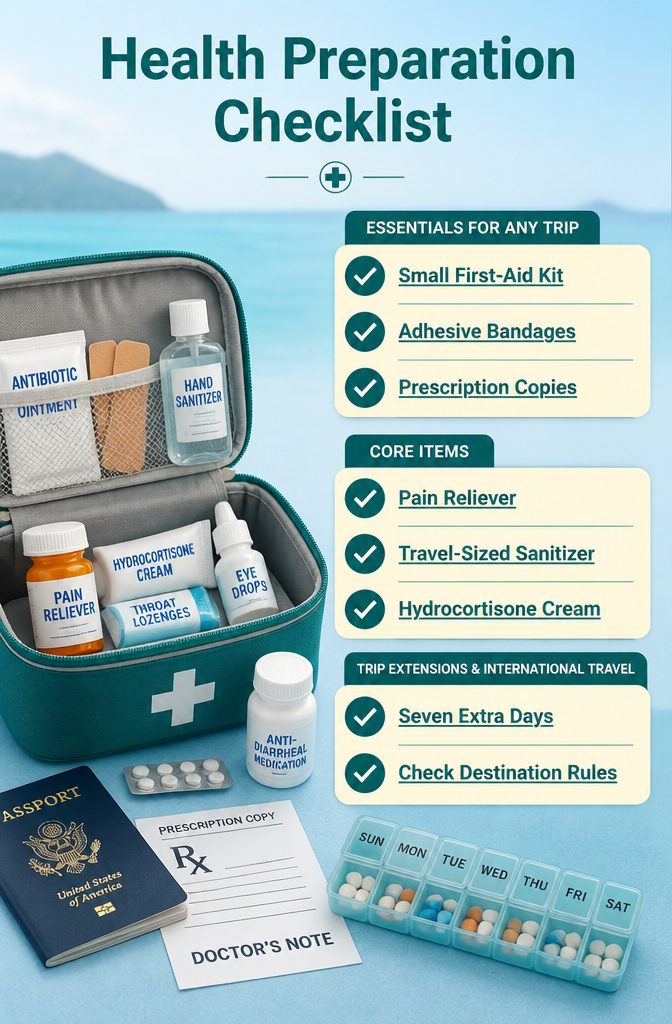
A small first-aid kit lives in my duffel no matter the trip length.
For a long weekend, that means adhesive bandages, antibiotic ointment, pain reliever, and hand sanitizer. A two-week trip adds hydrocortisone cream, eye drops, throat lozenges, and anti-diarrheal medication because a pharmacy may not be around the corner.
The original labeled containers for prescriptions travel in my carry-on, never checked, with copies of prescriptions and a doctor’s note for anything controlled.
I learned this the hard way after forgetting blood pressure medication on a four-day island hop. A local clinic could not refill it without the bottle and paperwork.
Now I pack seven extra days of everything, split between my bag and my partner’s, and set a phone reminder two hours before departure to verify the pill case.
International travel means checking destination rules before packing; some countries prohibit medications legal in the U.S. and penalties are severe.

【Packable Ultralight Jacket】Men's rain jacket waterproof is super lightweight, with packable carrying pouch, easy to keep in your handbag, travelling bag, suitcase or car. It's intelligently designed to allow minimal space occupation.

【Waterproof & Breathable】Rain jacket for men is made of high density soft shell fabric, high quality waterproof coating inside. Fully sealed seams further improve waterproof performance, advanced technology enhanced breathability that keep you cool and dry all day.

Waterproof & Windproof: APEXUP rain jacket for men features a 5000–8000mm waterproof coating, hot-pressed sealed seams, and waterproof zippers to help keep you dry and provide reliable protection in rainy and windy conditions
Destination-Specific Packing
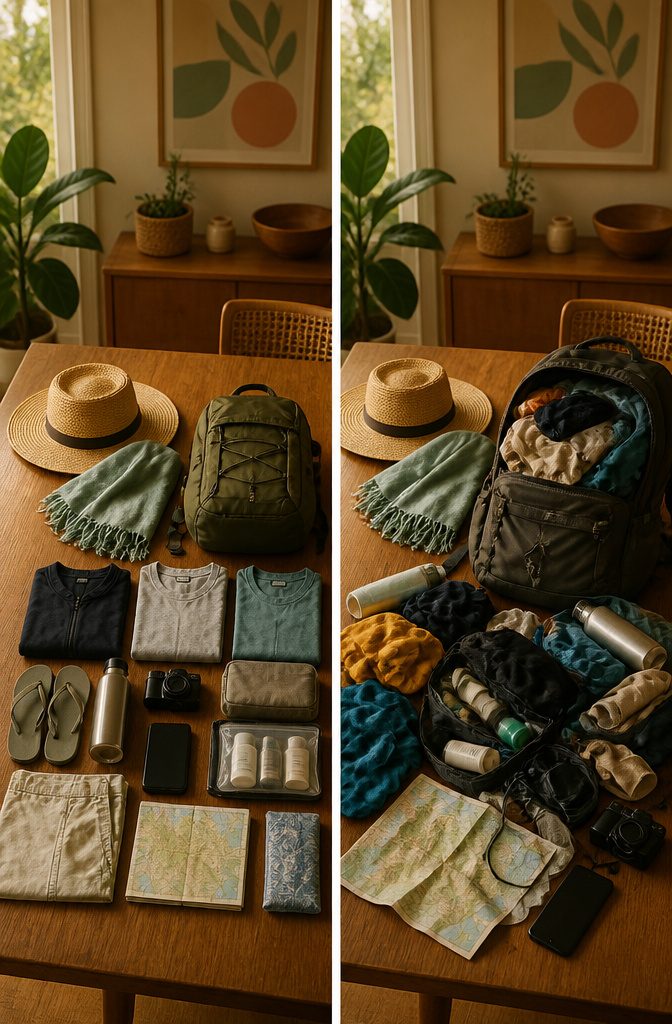
Beach vacations, hiking trips, and international travel each pull your bag in different directions, and the mistake I keep making is packing for the trip I picture instead of the one I’m actually taking.
Waterproof or windproof outer layers saved me in Iceland after I showed up with a "cute" trench coat that soaked through in thirty minutes of Reykjavik drizzle.
For Baja, I finally checked local conditions through regional weather stations and fishing reports before I packed, which meant quick-drying clothing and a hat with a real brim instead of the linen sundress I would have grabbed.
Hiking boots, a day pack, and snacks matter more than the gear list I used to obsess over.
I now skip anything that doesn’t layer or adapt. For beach vacations, water shoes and reef-safe sunscreen go in first; snorkel gear stays home unless I’m diving multiple days.
International trips get the same research block I now build into every plan: two hours reading local English-language forums and recent traveler posts about what the weather actually did last month, not what the averages say.

This 75-piece compact first aid kit comes in a zippered soft case, perfect for any size bag

ESSENTIALS FOR EMERGENCIES: Be prepared for unexpected situations with this first aid kit featuring 150+ essential supplies. It includes a variety of bandages, gloves, povidone-iodine prep pads, metal tweezers, a tourniquet, and more.

Intimate Emergency Helper😻 :Contains 27 basic emergency supplies, such as needles and threads to help you relieve the embarrassment of your clothes suddenly breaking, high-quality bandages to solve daily wound cleaning problems, heel pads to relieve friction pain, cotton swabs, nail files, etc.
Frequently Asked Questions
What should I pack for a week-long trip?
Pack six clothing pieces that mix and match into sixteen combinations: two neutral pants and four tops in a shared color story.
Add a quick-dry merino layer that works as both sleep shirt and hiking base layer, three pairs of shoes max, a quart-sized toiletry bag with 3.4 oz containers, your phone with an eSIM and power bank, and scanned copies of your passport and travel insurance.
How do I pack light for travel?
Roll clothes instead of folding, then compress them into packing cubes sorted by activity or outfit.
Wear your bulkiest items onto the plane: boots, jacket, and the one thick sweater. A carry-on-sized bag keeps you out of checked fees and carousel waits; anything you pack for a hypothetical moment and never unwrap is dead weight.
What are the must-have toiletries for travel?
Toothpaste, shampoo, and body wash in travel-sized containers under 3.4 oz, plus sunscreen and insect repellent.
A small first-aid kit with bandages, pain relievers, and antiseptic cream covers blisters and scrapes. Anything you take daily stays in your personal item; backup supplies can go in checked luggage.
What electronics should I bring on my trip?
Your phone, its charger, a universal travel adapter with multiple ports, and a portable power bank.
Add noise-canceling headphones for the flight plus corded headphones or a Bluetooth transmitter for in-flight entertainment. Skip the laptop unless work requires it, the tablet unless you read heavily, and any camera your phone already replaces.
How can I ensure my travel documents are safe?
Keep your passport in a slim document wallet on you, and scan every page to a cloud folder plus email a copy to someone at home.
Carry physical travel insurance cards, not just phone copies, after a dead battery left me stranded mid-conversation with a clinic. Add a written emergency contact card in the wallet, because phones lock.