
A Bali honeymoon delivers jungle seclusion, cliff-backed surf breaks, and beach clubs timed to sunset, but the experience shifts dramatically depending on which pocket of the island you choose.
Ubud’s morning walks through rice paddies run on a slower rhythm than Seminyak’s 5:00 PM beanbag rush at La Plancha, and the $30–$80 daily cost of a private driver quietly shapes what you can actually reach.
The couples who get it right book the spa treatments early and treat the Gili Islands’ two-hour boat transfer as part of the price for car-free silence.
Ubud
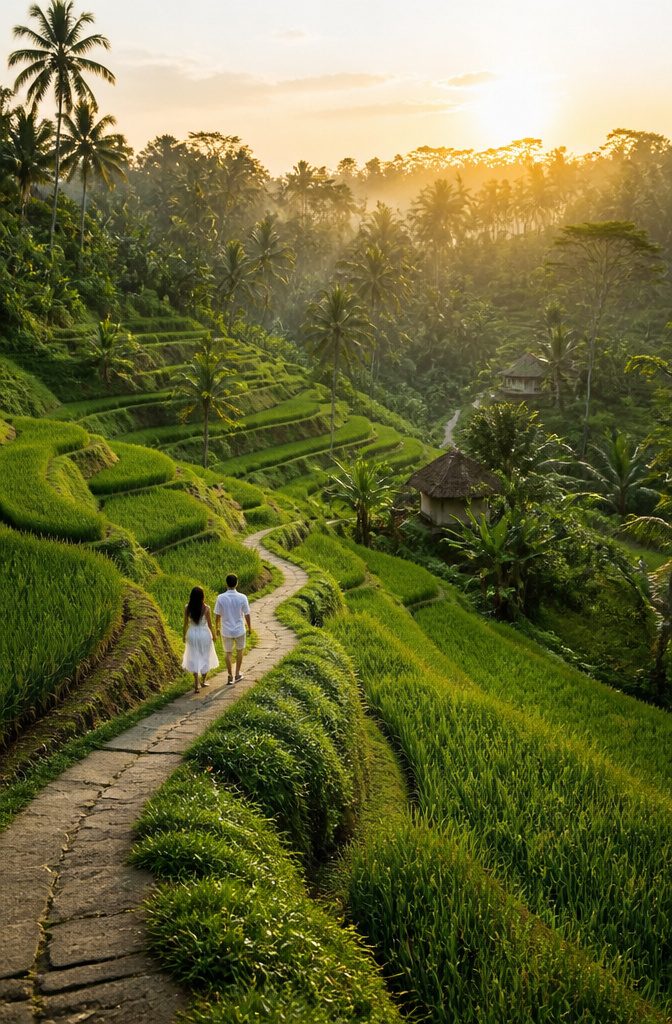
The jungle around Ubud works a slower rhythm than anything on the coast. Rice terraces step down hillsides in gradients of green, and couples who stay here trade beach clubs for morning walks through paddies that turn gold at sunrise.
Tegallalang is the one every source names first, though the lesser-known paths outside town draw fewer selfie queues.
Temple visits here carry actual ceremony, not just backdrop duty. The water temple lets you bathe in sacred springs; Goa Gajah delivers stone carvings from the 9th century without the tour-bus crush of Tanah Lot.
A private car with driver runs 500,000 IDR for the day, temple entries 10,000 to 15,000 IDR plus whatever you drop in donation boxes.
Spa treatments lean on what grows here: volcanic clay, frangipani, turmeric scrubs.
Most hotels build in yoga and meditation; the serious ones stage couples’ flower baths that feel less Instagram stunt than they sound if you book the quiet afternoon slots.
The town itself has galleries and enough decent dining to keep you fed, though "town" is the wrong word. Ubud strings along a few roads, then dissolves back into forest and farmland.
The pace forces a shift. By day three you stop checking sunset times because nothing here depends on them.
Ubud is recognized as the top honeymoon destination in Bali, known for its lush jungle and tranquility.
That tranquility is the sell, but it is also the trade.
Nights end early. The nearest surf break is an hour south.
For couples who want culture without the backpacker density of the 1990s, or quiet that still has things to do, Ubud is the choice. For nightlife, it is not.
Uluwatu

The cliffs at Uluwatu drop straight to surf breaks that draw both experienced surfers and first-timers, which sets the geography apart from the gentler coasts farther north.
That vertical edge creates a different rhythm: mornings on a board, afternoons at a beach club, evenings watching the sky darken over the temple.
Book Kecak fire dance tickets in advance for the cliff-top performance at Pura Lulur Watu.
The dance runs at sunset, and the timing matters because the ceremony layers human voices and fire against the actual light disappearing, not a stage version of it.
The area sits about 40 minutes from the airport, far enough that the aqua-blue water comes with a quieter, less mapped feel than the strips around Seminyak or Canggu.
Beach access here means stairs or paths cut into the cliff face, so the coves stay emptier.
For couples, that trade-off is the point: you lose the ease of stepping straight onto sand, and you gain pockets of shoreline that do not read as shared public space.
Surfing fills the adventure side lightly, without requiring full commitment.
Lessons work for beginners, the breaks work for the skilled, and neither group crowds the other because the cliff geography spreads access points across miles of coast rather than concentrating them.
Seminyak
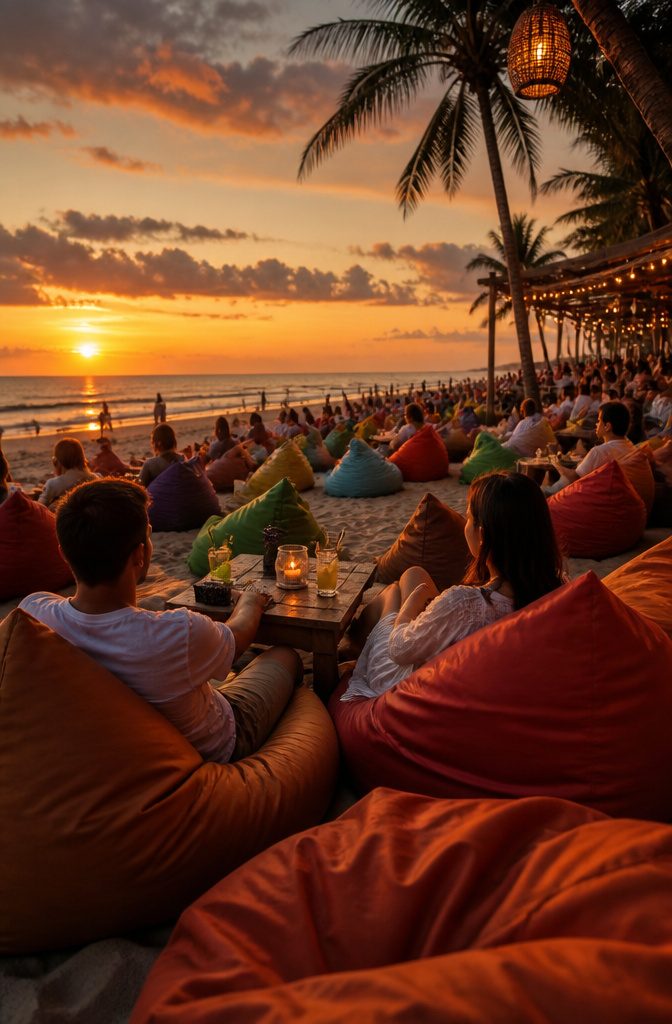
Seminyak earns its place on honeymoon itineraries for one reason: it concentrates the things couples actually want into a walkable stretch.
Upscale dining here means restaurants like Sea Circus for brunch and Motel Mexicola for dinner, both solid enough to justify a reservation rather than a walk-in hope.
The beach clubs operate on a timing logic most first-timers miss. Potato Head draws the dressed-up crowd from mid-afternoon onward, while La Plancha fills earlier with people who came for the sunset itself, not the scene around it.
Arrive at La Plancha by 5:00 PM to claim a beanbag with an unobstructed westward view; by 6:30 the prime spots are shoulder-to-shoulder.
The shopping runs to international designer boutiques, not souvenir stalls, which explains the luggage-space anxiety the area produces.
I would not plan a full day of it unless both halves of the couple enjoy retail scouting; two hours before the heat peaks, then retreat to a hotel pool, is the workable rhythm.
Nightlife splits cleanly between advertised and actual. La Favela opens late and stays busy with dancing, while many of the "vibrant nightlife" spots marketed online are essentially restaurant bars that close early.
Stay at The Legian if the budget allows; its position in the thick of Seminyak cuts taxi dependency significantly, and the traditional Balinese design holds up against newer builds that chase trends.
Tijili Seminyak offers a boutique alternative with more personality than the chain options, though you trade some immediate beach access for it.
Canggu
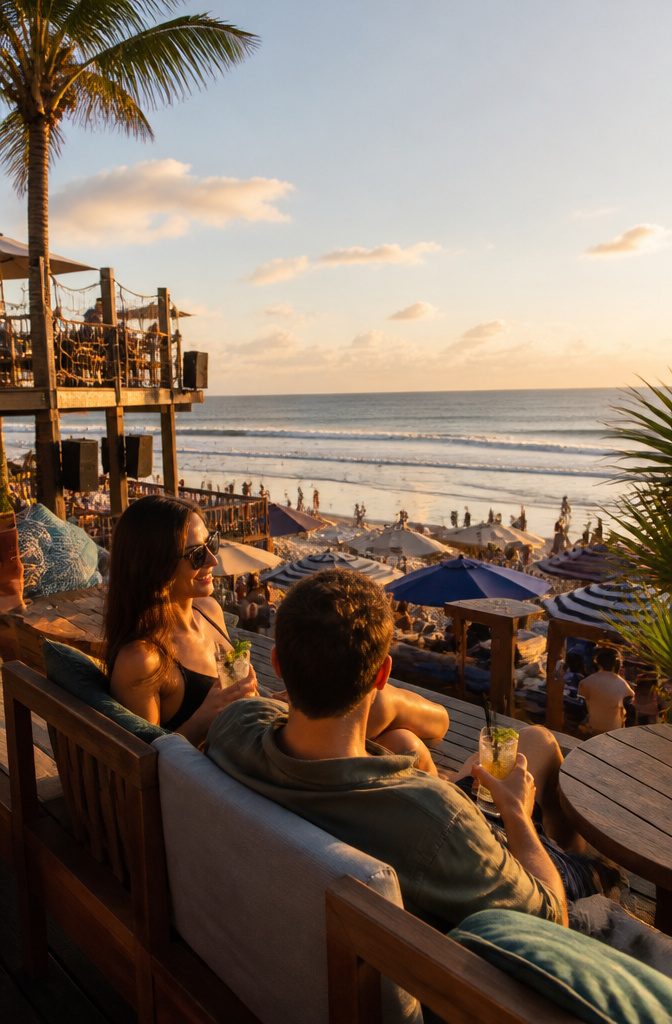
Canggu used to be a scatter of warungs and surfboard rentals; now the main drags run dense with Australian-style cafes, cold brew on tap, and coworking spaces that rent by the day.
The shift is complete enough that "digital nomad" is the default tourist type, not the exception.
What saves the place for some couples is that the old casual thread still runs through it: rice paddies persist behind the villas, and the beach breaks at Batu Bolong stay free to watch even if you do not surf.
For a honeymoon, Canggu makes sense only if both of you actually want the scene.
Seminyak delivers cleaner sand, easier swimming, and service standards that match the price; Canggu trades that for a looser rhythm and lower nightly rates on comparable villas.
The beach clubs here, Finn’s and the smaller setups along Berawa, charge entry that runs toward $30 on busy afternoons, with daybed minimums that can double that on weekends.
Sunset is the draw, and the timing matters: arrive by 5 PM or queue for parking that barely moves after.
Traffic from the airport routinely hits 90 minutes in peak hours, and the narrow roads inside Canggu clog by mid-morning.
Scooters are the practical choice, which is fine if you rode before; if not, the honeymoon becomes a driving lesson you did not plan.
Nusa Dua
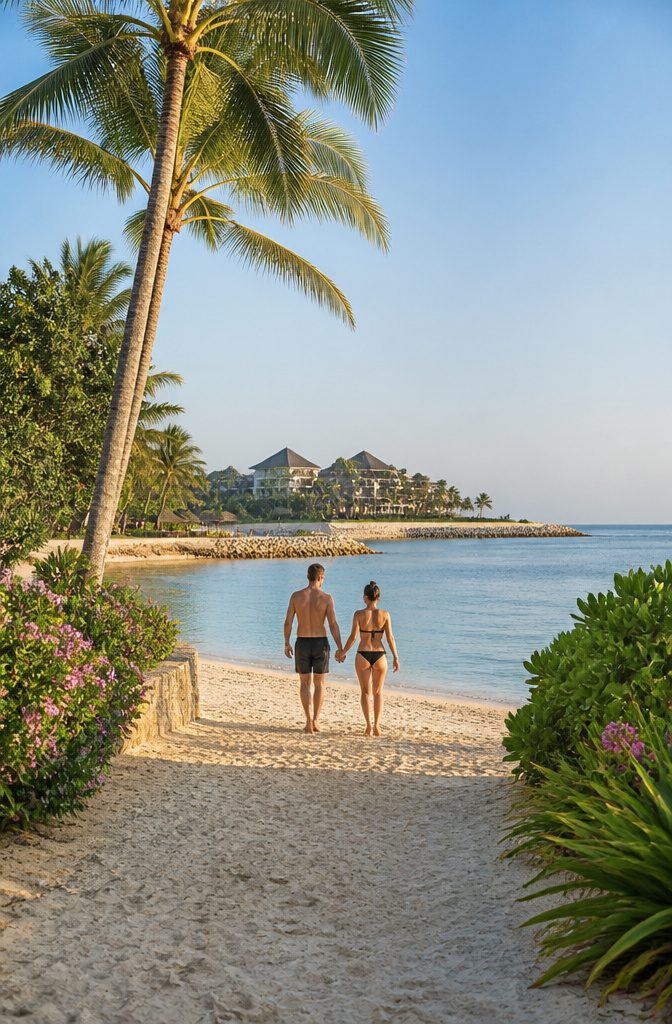
Nusa Dua sits behind a gated entry on Bali’s southern tip, a purpose-built zone where calm, swimmable water matters more than street-level culture.
The beaches here face east into a sheltered strait, so the swell that pounds Uluwatu and Canggu barely reaches ankle height. That stillness is the draw.
The "traditional honeymoon experience" translates to predictable service tiers and meal-plan structures. Most properties run half- or full-board packages, which suits couples who want to settle in and not think about where dinner comes from.
Golf courses and convention centers share the same manicured grounds; you will notice the conference signage in lobbies some weeks.
What you trade is proximity to Balinese daily life. No warung alleys, no evening temple processions wandering past your gate.
Seminyak and Canggu sit close enough for day trips, but the resort bubble is the point here. For couples who rank reliable air-conditioning and poolside quiet above serendipity, that trade reads as feature rather than flaw.
Gili Islands
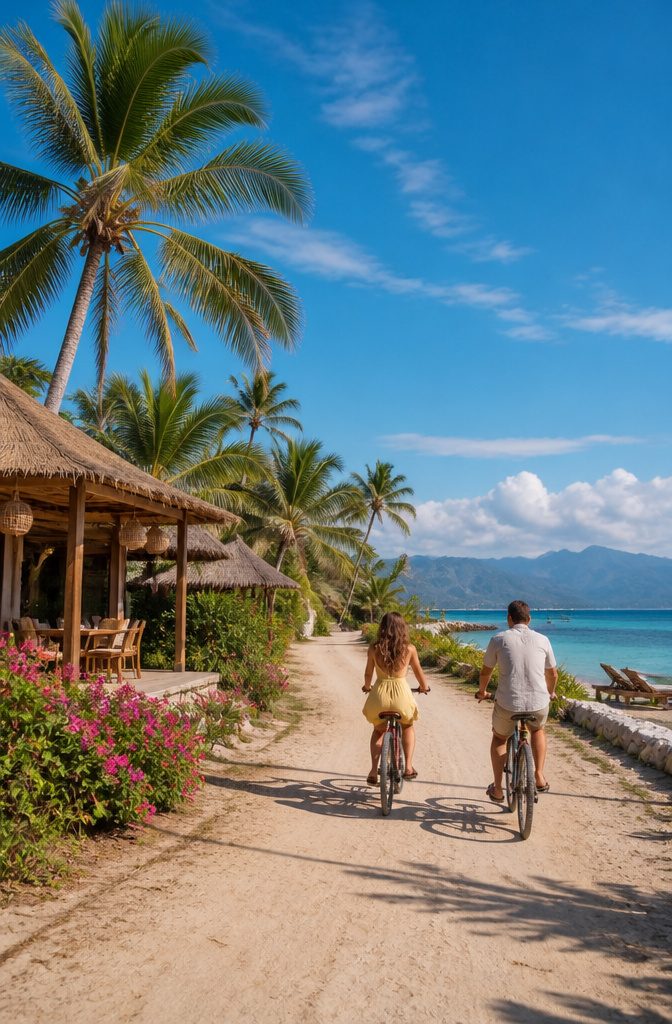
The Gili Islands sit off Lombok’s coast, not Bali’s, though nearly every honeymoon itinerary routes through Bali to reach them.
No cars or motorbikes run on any of the three; walking, bicycles, and the occasional horse-drawn carriage move people around instead. That single rule shapes the whole experience.
Gili Trawangan draws the social crowd with its bars and restaurants, Gili Meno stays quiet and thinly populated for couples who want little more than each other and the water, and Gili Air splits the difference with small farms and simpler wooden stays.
The boat logistics are the catch: plan on roughly two hours by car to the departure point, then another hour on the water, and the ride itself is basic, not luxury.
Snorkeling delivers what the islands are known for, coral gardens and turtle sightings, with enough regularity that swimming with one feels likely rather than lucky. By night, seafood grilled on the beach under strung lights is the standard evening.
For a honeymoon, Meno wins if isolation is the goal, Air if you want some life without Trawangan’s volume, and Trawangan only if you actually want the party mixed in with the paradise.
Nusa Penida

The west coast of Nusa Penida is where the island earns its reputation.
Kelingking Beach, Angel’s Billabong, and Broken Beach sit within a few kilometers of one another, each offering a different angle on the same raw geology: arches, sinkholes, and cliffs that drop straight into water the color of stained glass.
Broken Beach is the standout, with its natural stone arch framing an impossibly blue lagoon. Angel’s Billabong, the tidal pool that doubles as an infinity pool on Instagram, is less appealing in person.
Waves have swept visitors into the rocks there, and actual injuries have happened during short visits. The view from above is the safer shot, and often the better one.
Manta Point lives up to its name.
The snorkeling and diving here ranks among the best in the region, with manta rays and the occasional dolphin passing through. It sits minutes on foot from Broken Beach, which makes the west coast loop efficient for a single day.
The infrastructure is the real decision point. Roads are rough, transport is limited, and accommodation options are sparse compared to Nusa Lembongan next door.
A day trip from Sanur, with boats running around 9:00 AM, covers the highlights without the hassle of staying over. Seminyak or Ubud work as departure points too, though operators charge more for the pickup.
Overnight stays suit only those who want sunrise at the cliffs and do not mind basic conditions. For most honeymooners, the day trip is the smarter play: the same formations, the mantas, and a comfortable bed back in Bali.
Sidemen
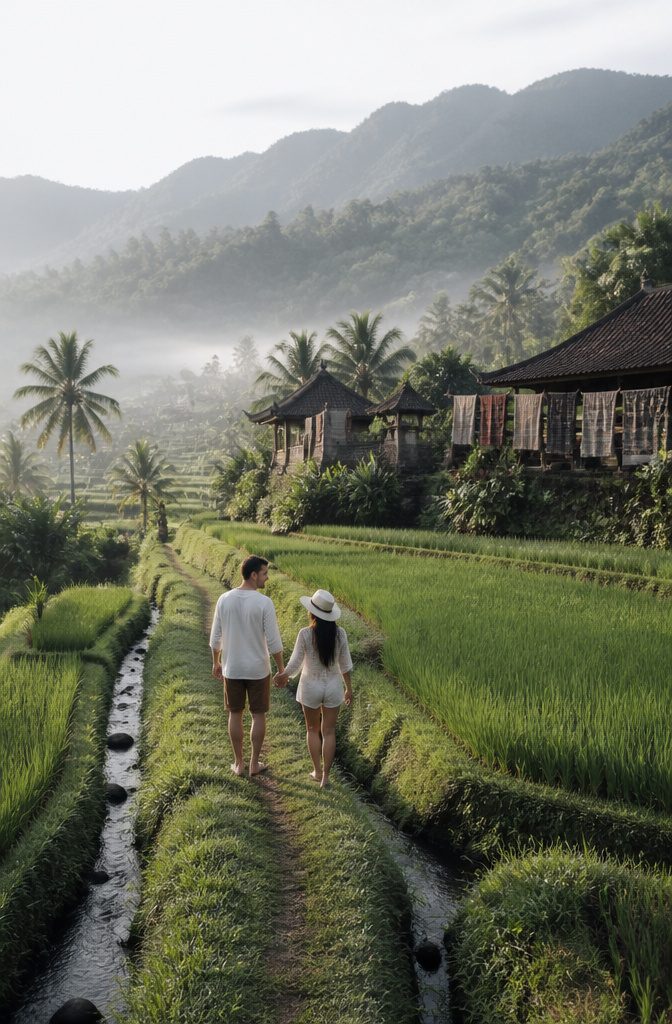
The rice terraces in Sidemen run valley to ridge on both sides, a scale that makes the Tegallalang snapshots look like garden plots.
You will spend two hours minimum reaching this east Bali valley from Ubud or the airport, and the road narrows to one lane where the irrigation channels cross.
That friction keeps the guest count low; maybe a dozen small lodges and family compounds take visitors, with none of the villa density that turns Seminyak into a construction zone by 2026.
Seclusion here means eating where you sleep or riding a scooter to the one strip of warungs in the village center. Evenings end early; there is no beach bar, no sunset DJ, no reason to stay up past the geckos.
What you get, if you are the couple who wants it, is walking the irrigation paths alone at first light when the mist still sits in the paddies, or sitting with a weaver while she works the ikat threads and names the dye plants she grows behind her house.
I would not send a pair who needs dinner reservations and cocktail menus. For two people who packed a book and comfortable shoes, Sidemen is the argument for skipping Ubud entirely.
Lombok
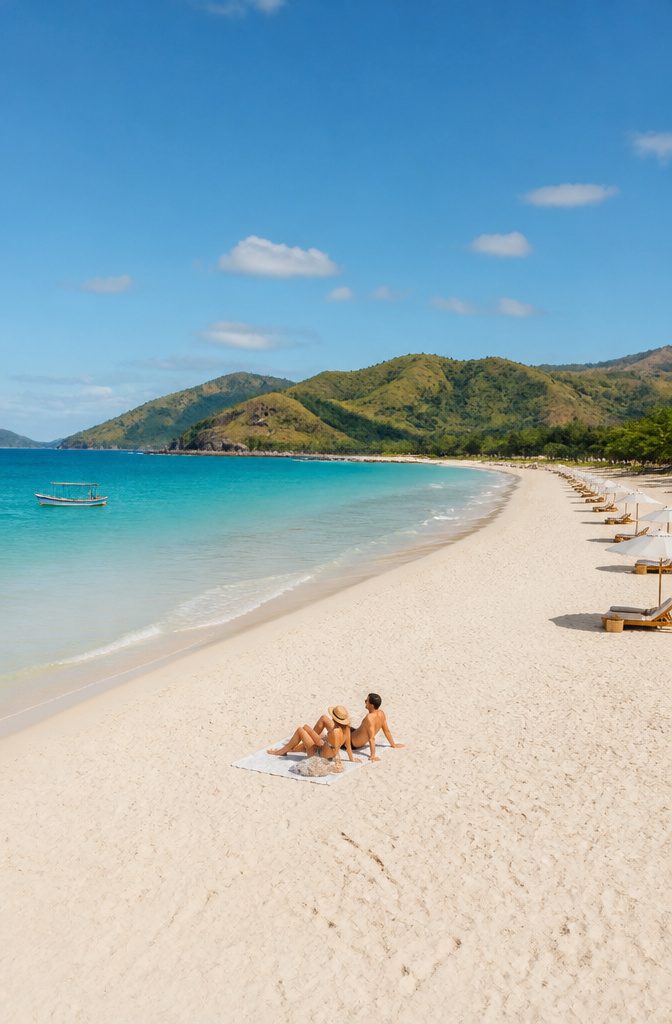
Lombok sits about 30 km east of Bali, close enough for a scenic 30-minute flight but separated by a stretch of water that keeps the crowds on the other side.
The south coast beaches are the draw: Selong Belanak, Mawun, and Tanjung Aan run to white sand and turquoise water with far less built-up infrastructure than anything in Bali’s south.
That distinction matters. Less touristy here means fewer restaurants, fewer ATMs, and fewer transport options after dark, not just a quieter vibe.
You give something up for it. A day trip by car rental runs about 500,000 IDR, and you will need one because the south coast is spread out and taxi coverage thin.
For accommodation, the Tugu Lombok offers 19 rooms on a horseshoe bay with serious design attention, while the Jeeva Beloam Beach Camp pushes further out: five thatched buildings on a deserted cove, no pool, no spa, just the cliff face and a chef who cooks what you catch.
Novotel Lombok Resort and Villas in Kuta anchors the more conventional option with full resort facilities.
I would send couples here who have already done Bali’s temple-and-rice-terrace circuit and want three days of actual stillness.
The extra flight or ferry time pays off only if you commit to the isolation. If you need evening dining options or worry about medical access, stay on Bali and day-trip to the Gili Islands instead.
When to Go
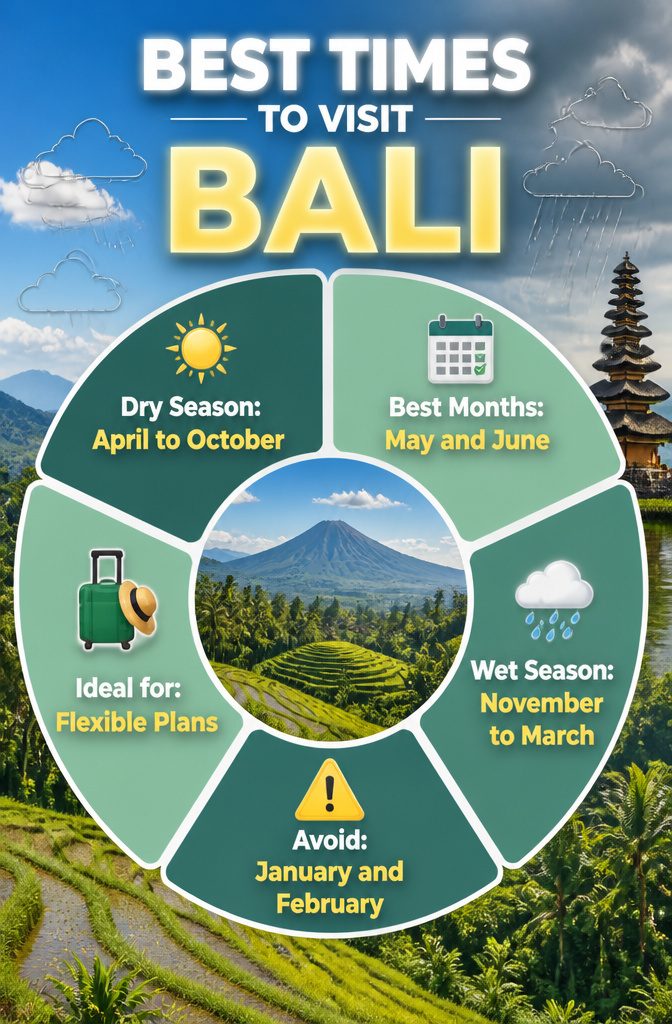
Bali’s dry season runs April through October, with May and June offering the best balance of clear skies and manageable crowds before the July–August surge drives hotel rates up.
The wet season spans November through March, though the pattern matters more than the label: afternoons bring heavy but brief showers, and the rest of the day often clears.
Roads in lower-lying areas can flood after sustained rain, and some outdoor excursions simply pause until conditions improve.
January and February are the months to avoid. The rainfall is heavier then, and the humidity sits high enough to limit how much you actually want to do.
The trade-off for wet-season travel is real: fewer visitors, lusher rice fields, and lower accommodation prices. For a honeymoon, though, that only works if your plans are loose enough to roll with cancellations and rescheduling.
North Bali stays more viable through the wet months, with dense jungle, waterfalls, and hot springs that don’t depend on beach weather.
What a Bali Honeymoon Costs

A week in Bali runs $130–$640 per person on a tight budget, or $1,700–$2,650 for a high-end honeymoon. Those figures exclude flights, so the gap between scraping by and splurging is narrower than it first looks.
The budget end covers basic hotels around $50 a night, meals at $5, and transport by scooter or shared shuttle at $5–$30 daily.
Mid-range sits at roughly $1,020–$1,810 per person, where a private villa with a pool starts to enter the picture and food climbs toward $25–$50 per day.
Luxury at $1,700–$2,650 buys the freestanding pool villas that Bali is famous for, plus full-service dining and private drivers in the $50–$80 range.
The real squeeze happens in accommodation.
A 5-star experience in Bali often costs what a 3-star does in North America or Europe. That means the jump from a nice mid-range villa to a top-tier resort is sometimes only a few hundred dollars for the week.
Meals and transport do not widen the gap much; the money goes to where you sleep. If the budget allows any flexibility, that is where to spend it.
Getting Around
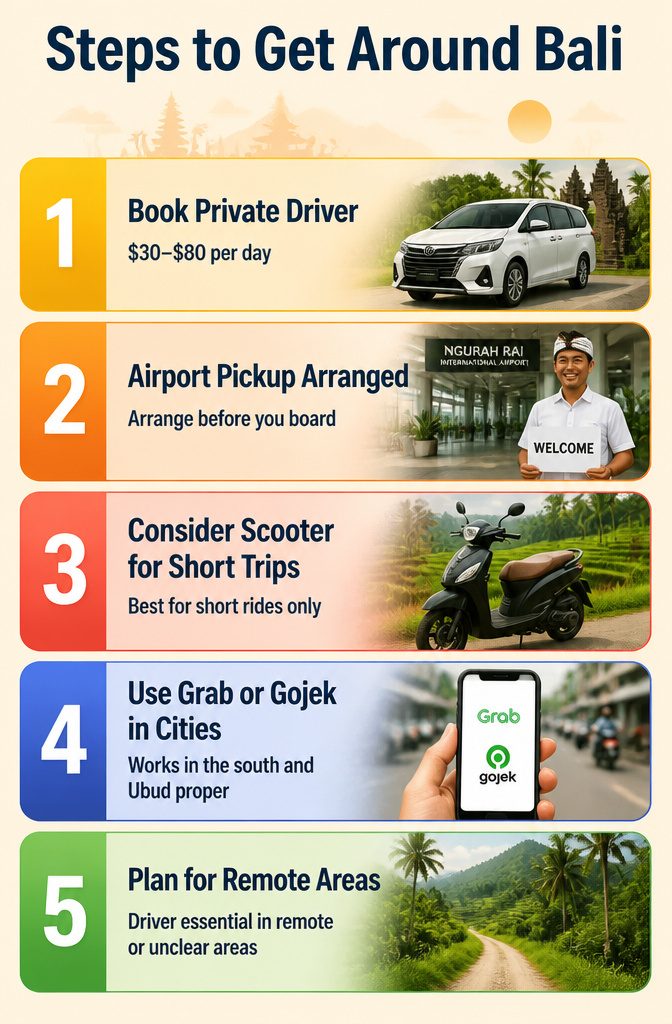
A private driver runs about $30–$80 per day and is the option that actually makes sense for a honeymoon.
The rate often beats piecing together taxis, and you get someone who knows which roads flood in January and which warung closes without warning.
Book ahead and line up your airport pickup at the same time; some Ubud resorts include the transfer in their package, which removes one variable from a long flight day.
Scooters cost less, but honeymoon traffic is different.
You are not backpacking through Kuta at twenty-two. The helmet hair, the diesel exhaust in humid air, the occasional road rash: these are not romantic memories in the making.
Grab and Gojek work in the south and in Ubud proper.
In Sidemen, the north, or anywhere the apps gray out, a driver becomes essential, not optional. The same applies if your villa sits up a dirt track with no pin drop.
For airport logistics, Ngurah Rai sits close enough that most couples reach their hotel within a couple of hours of landing.
Arrange that first ride before you board. Everything after, your driver handles.
Where to Eat
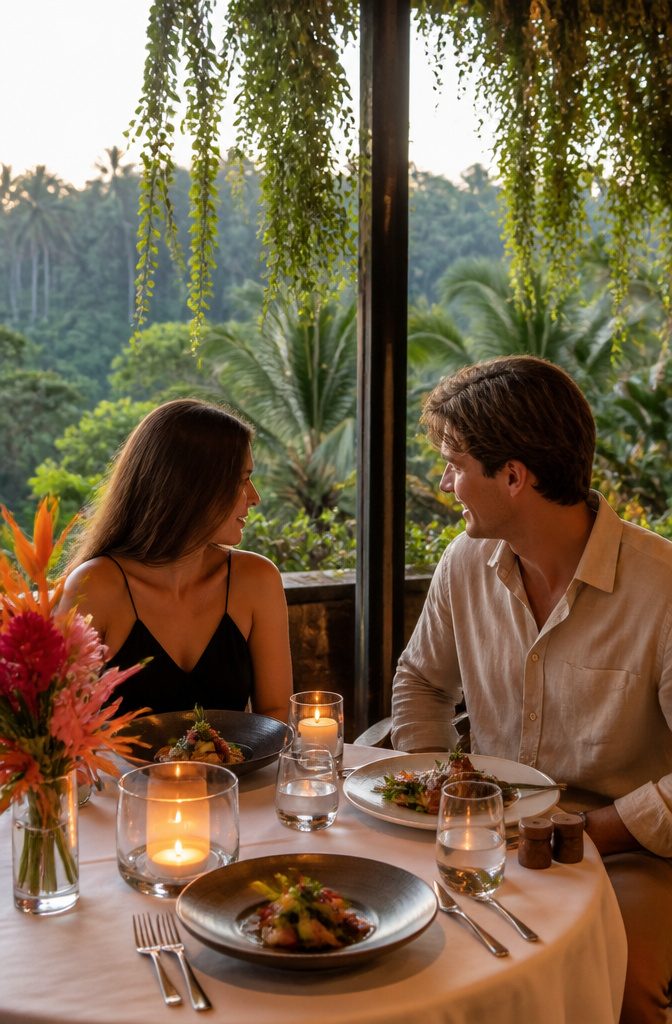
Bali’s dining runs from a $3 plate of nasi goreng at a roadside warung to a seven-course degustation at Apéritif, where the Belgian chef and candlelit jungle valley setting make it Ubud’s clear choice for one splurge night.
Reserve KUBU at the Ritz-Carlton if you want private bamboo dining pods over the Ayung River, or Begawan Biji for farm-to-table Asian plates without the resort markup.
For sunset, timing matters.
Chupacabras delivers jungle views and steak as the light drops, while Ambar Bar at the same Ritz-Carlton property handles Japanese small plates with a less formal vibe. Both fill by 5:30 p.m. for the 6:15 golden hour.
Eat the local stuff: babi guling, lawar, fresh sambal.
Stick to restaurants with turnover, avoid ice from uncertain sources, and carry a basic kit for the Bali belly that hits roughly one in three travelers regardless of how careful they are.
The warung-to-resort spread on a comparable dinner runs about $4 to $120 per person.
What to Do Together
A honeymoon in Bali lives or dies on the planning, not the price tag.
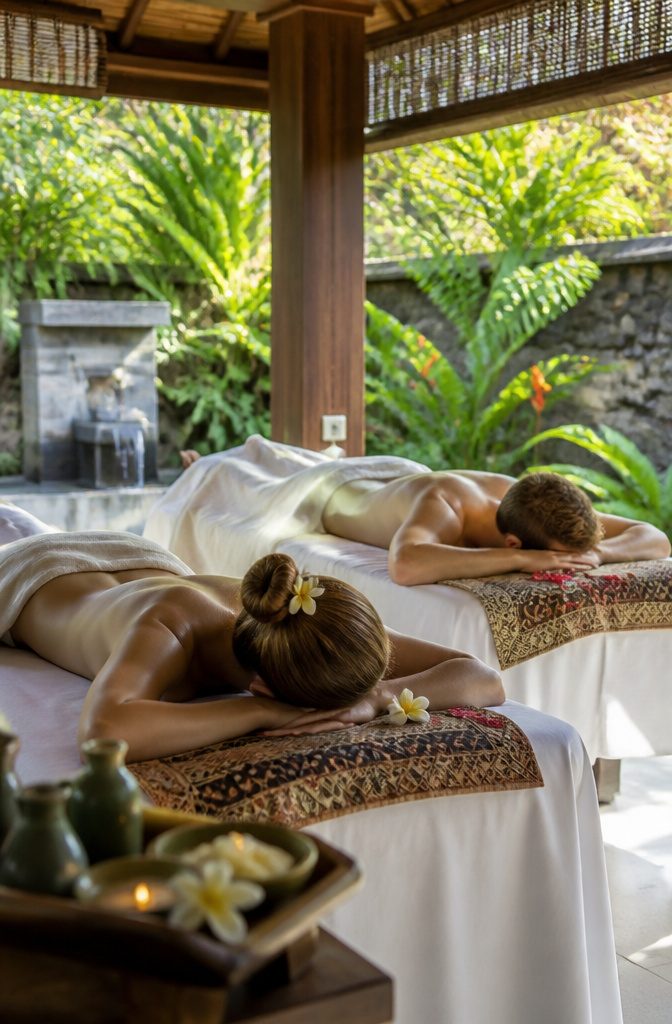
The couples spa treatment is the one to book early; most of the good resorts require 48 hours’ notice, and the two-hour session with body scrub, mask, and massage is what actually justifies the cost against a standard hour-long rubdown.
The flower petal bath and floating breakfast are included in most packages, so do not pay extra for them a la carte.
- Candlelit dinners are standard at places like Veluvana in Sidemen, where the bamboo houses include one in your cabin, but the architecture is the real draw; the cobra and manta ray shaped structures photograph better than they sleep, and the steep per-night rate only makes sense for a short stay.
- Temple visits reward timing.
- Traditional dance performances are marketed heavily in package descriptions, yet none of the honeymoon sources single one out as worth the evening; skip it for a second spa session or a rice paddy hike instead.
- The welcome gifts, sparkling wine, chocolate cake, and red roses are included at properties like Viceroy Bali; they feel thoughtful once, then clutter the villa for three nights, so ask to receive them on departure if you want the gesture without the mess.
Frequently Asked Questions
What are the best areas to stay in Bali for a honeymoon?
Ubud, Uluwatu, Seminyak, Canggu, Nusa Dua, the Gili Islands, Nusa Penida, Sidemen, and Lombok each suit different couples.
Ubud delivers jungle quiet and culture; Uluwatu pairs cliff-top temples with surf; Seminyak concentrates dining and beach clubs into a walkable strip; Nusa Dua offers calm, swimmable water behind gated resorts.
The Gilis ban motorized transport entirely, while Sidemen and Lombok trade convenience for actual isolation.
What is the best time to visit Bali for a honeymoon?
April through October, with May and June as the best stretch for clear skies and manageable crowds before the July–August rate surge.
November through March brings brief but heavy afternoon showers; January and February are the months to skip, with sustained rainfall and humidity high enough to limit activity.
North Bali stays more viable through the wet season, with jungle and hot springs that do not depend on beach weather.
What romantic activities can we do in Bali?
Book the couples’ spa treatment early, most good resorts need 48 hours’ notice, and the two-hour session with scrub, mask, and massage justifies the cost against a standard hour-long option.
Candlelit dinners come standard at places like Veluvana in Sidemen, though the bamboo architecture photographs better than it sleeps for a long stay.
Temple visits work only at dawn or dusk; midday heat and crowds kill the mood. Skip marketed dance performances for a second spa session or a rice paddy hike instead.
How much does a honeymoon to Bali cost?
A week runs $130–$640 per person on a tight budget, $1,020–$1,810 mid-range, or $1,700–$2,650 for a high-end trip, all excluding flights.
The real spread is in accommodation; a 5-star experience in Bali often costs what a 3-star does in North America or Europe, so the jump from nice mid-range to top-tier is sometimes only a few hundred dollars for the week.
Spend any flexibility there, meals and transport widen the gap far less.
Can ladies wear shorts in Bali?
Shorts are fine at beaches, beach clubs, and resort pools across Bali, but temple visits require covered shoulders and knees out of respect; a sarong solves this and most temples rent or provide one.
The same modesty applies to rural villages and family compounds, where local dress norms run more conservative than tourist zones. Pack light layers; humidity makes synthetic fabrics uncomfortable by mid-morning.





