
Trips to Go is a membership-based booking platform that connects travelers directly to airline, hotel, and tour operator inventory rather than reselling through aggregator layers.
Most of its features only earn their keep if you travel twice or more per year; the annual membership breaks even around the second trip, and perks like live pricing and flexible itinerary changes matter most when you are booking inside a three-month window.
A starting trip price of $1,467 means the $60 average coupon savings is modest, but it sits on top of a figure that already includes mandatory fees most sites hide until checkout.
24/7 Customer Care That Actually Answers

An 11 PM flight cancellation is where 24/7 support proves whether it exists on paper or in practice.
Most booking sites list a help number; actually reaching a human who can rebook you before the last hotel shuttle leaves is another matter entirely.
The support teams for this service get high marks for responsiveness and professionalism, which matters when you are standing at a deserted gate with a dead phone battery.
Travelers report smooth issue resolution rather than phone trees that loop back to the same recording.
Direct connections to airlines and hotels help here too. A support agent with a pre-existing relationship to the provider can sometimes hold a room or secure a seat that a generalist calling the public line cannot.
That is the difference between sleeping near the airport and making the trip you planned.
Round-the-clock availability is only worth paying for if you actually use it.
Book everything three months out with no changes, and you might never dial the number. Change a single redeye connection in a city you do not know, and it pays for itself in one night.
Direct Provider Connections

Most booking sites sit between you and the actual airline or hotel, scraping data that goes stale the instant a fare changes.
Trip To Go skips that layer entirely. Its system connects straight to the provider’s own inventory, so what you see is what still exists at that price.
A direct pipe matters most when supply is tight. Aggregators can show a $287 room that was already booked twenty minutes ago; by the time you click through three redirects, the rate jumps or the room vanishes.
Trip To Go’s live link means the price you are quoted is the one the provider is actually offering right then, not a cached guess.
The material benefit is time saved and surprises avoided. I would rather know a flight is gone than waste ten minutes filling in forms for a seat that was never there.
For travelers booking inside that three-month window, where prices shift fast, that accuracy is the difference between locking in a decent fare and starting over at a higher tier.
Pricing With No Surprise Fees
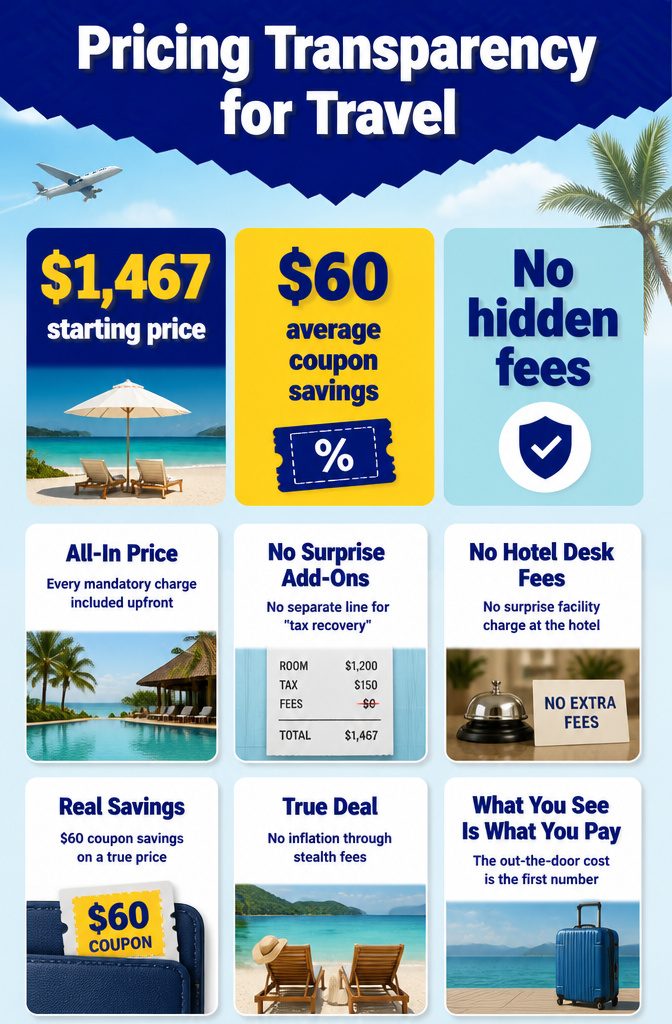
The starting price for most trips runs $1,467, and the coupons floating around right now knock off about $60 on average.
That figure only matters if it is the real out-the-door cost, and the travel industry has trained most of us to expect otherwise.
Resort fees, destination charges, and booking service add-ons usually appear after the headline price has already done its work on your psychology.
The "no hidden fees" claim I look for means the opposite: every mandatory charge is folded into that first number, not unrolled at checkout. No separate line for "tax recovery," no surprise facility charge at the hotel desk.
The $60 coupon savings is modest, but it lands on top of a price that does not inflate itself back up through stealth fees. That combination is what separates an actual deal from a headline that merely sounds like one.
Comprehensive Travel Solutions

Trips to Go covers flights, hotels, tours, and transfers in a single booking flow, which matters more than it sounds when you’re piecing together a multi-stop itinerary yourself.
The platform pulls from direct connections to airlines, hotels, and tour operators rather than reselling through middle layers, and that structure is what lets them bundle the pieces without the markup stacking at each step.
Personalized recommendations are built into the search, not bolted on after.
I find that useful when I’m weighing whether to book a flight and hotel separately or take the package; the tool surfaces combinations I would have missed running tabs across three sites.
What I cannot confirm from the material is how deep the tour catalog runs. Check the specific itineraries and destinations against your particular trip rather than assuming they are a known strength.
Transfers round out the set, and for island destinations like Salt Spring, that last-mile piece often decides whether the "affordable" flight arrival actually works.
A package that includes the seaplane or ferry connection saves the separate booking headache, though I would verify the transfer timing against actual schedules before committing.
Flexible Itinerary Options

"Flexible" in travel booking usually means you can move a flight or swap a hotel, but the change fee often eats the savings you thought you had.
Trip To Go builds its flexibility into the structure before you pay, not as an afterthought you negotiate later.
Multi-stop trips are where this actually matters.
A standard booking engine treats each leg as separate inventory; move one and the others stay fixed, which is how you end up with a 6-hour layover in a city you never wanted to see.
Trip To Go keeps the full itinerary in one container, so shifting the second stop automatically recalculates the third and fourth.
The window for changes without penalty runs wider than the 24-hour airline rule most travelers know, though not as wide as the premium fares that cost 40% more.
What you can move depends on what you booked. Hotels and tours generally shift easier than flights, since the platform holds those relationships directly rather than pulling from a global distribution system.
Ground transportation is the most fluid; in most markets you can modify the pickup time or vehicle size up to 48 hours out without a fee.
The trade-off shows up in the booking path itself. You will see "flexible" tags on some options and not others, and the price difference is usually 8–15%.
I pay it when the trip involves more than two stops or when I am booking inside that 3-month window where work schedules still shift. For a single round-trip with fixed vacation days, the math rarely works.
Travel Protection Plans
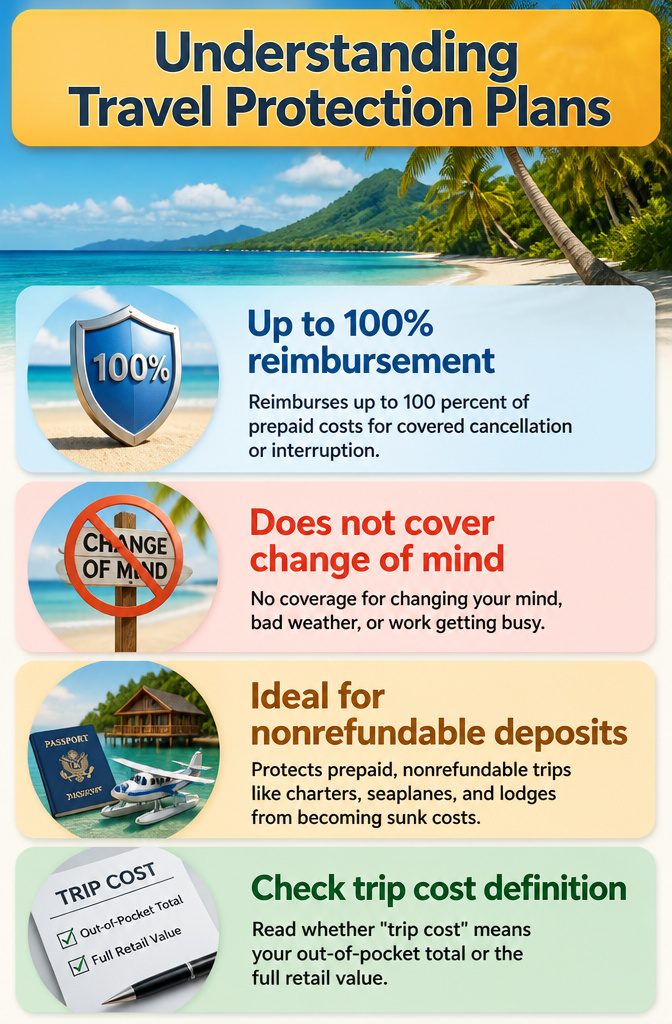
Travel protection on these trips to go plans reimburses up to 100 percent of prepaid costs when cancellation or interruption falls under covered reasons, which typically include illness, injury, or a family emergency that forces you home mid-trip.
What it does not cover matters just as much: changing your mind because the forecast shifted, or bailing on a trip because work got busy, leaves you without recourse unless you bought a pricier cancel-for-any-reason upgrade.
The policy structure rewards people with nonrefundable deposits and tight connection windows. A $2,400 island-hopping package with four separate ferry legs has more breakable links than a single direct flight to a hotel with free cancellation, so the math tilts differently.
I skip it when I am booking fully refundable rooms and flexible flights, and I buy it when a charter seaplane or a prepaid lodge booking would otherwise turn into a sunk cost if one link snaps.
The interruption piece is the one I watch most closely: some plans only cover the unused portion, while better ones also cover the extra fare to rejoin a trip already in motion.
Read whether "trip cost" means your out-of-pocket total or the full retail value, because the gap between those two numbers is where a claim can fall apart.
Membership Plans
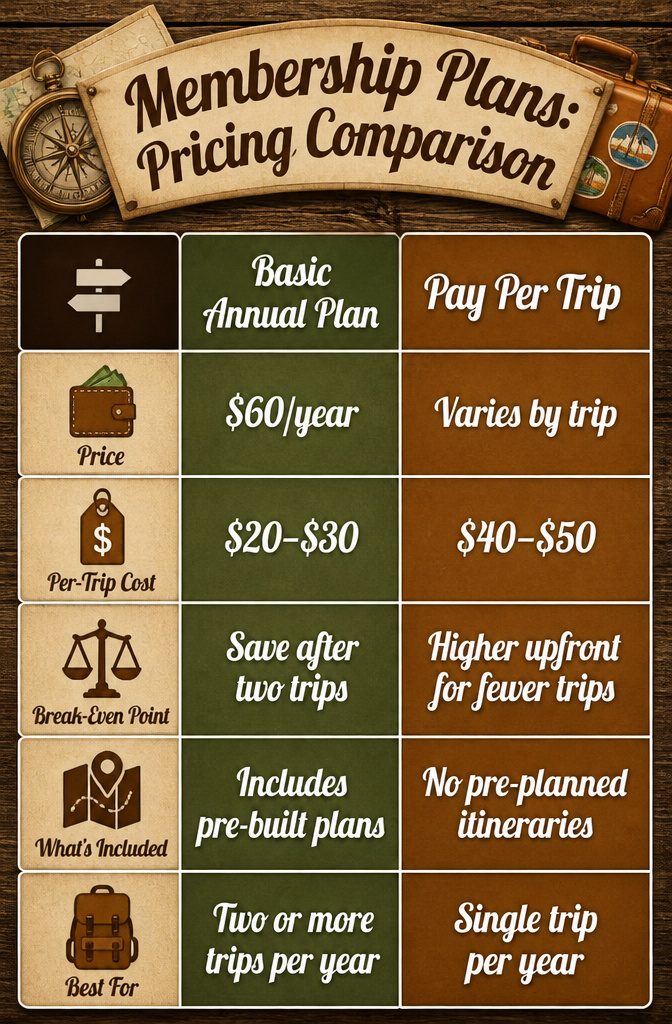
Access to full itineraries sits behind a single membership wall, and the math only works if you travel often enough to amortize the fee.
A basic annual plan runs about $60, which unlocks every route in the catalog instead of charging per trip. For someone booking two or three getaways a year, that per-trip cost drops to roughly $20–$30, against $40–$50 for individual purchases.
The break-even point lands around the second trip, not the first, so occasional travelers pay slightly more upfront than they would buying à la carte.
What the membership actually buys is time saved: pre-built day-by-day plans with transit connections already mapped, which matters more than the raw dollar savings if you book trips inside that three-month window and need decisions made fast.
I would take the annual plan for any year with two or more planned trips, and skip it for a single vacation.
Customer Satisfaction Record
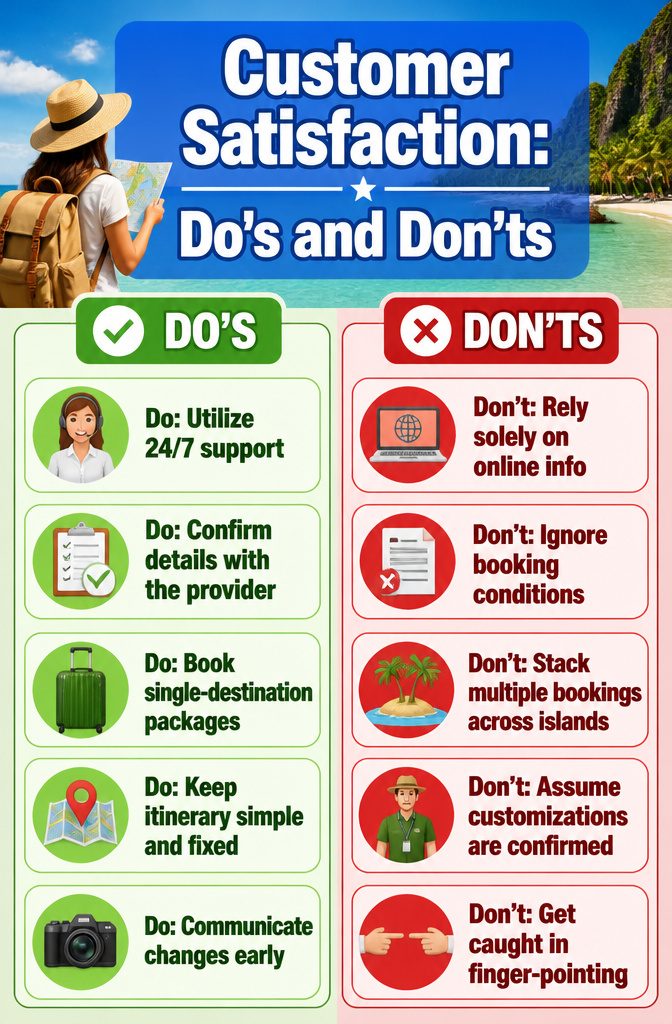
Trip to Go’s 24/7 support team gets mentioned in positive reviews for professionalism and responsiveness, but the same structure creates two very different outcomes depending on what goes wrong.
Travelers who hit straightforward issues, a missed connection or a hotel mix-up with a direct provider on the platform, tend to report smooth resolution and praise the knowledgeable local guides and quality accommodations that followed.
The dissatisfied cases cluster around problems the 24/7 desk cannot actually fix, a tour operator that never confirmed, a customization that did not reach the ground team, situations where the direct connection to providers became a finger-pointing loop rather than a shortcut.
For a self-planner booking inside a three-month window, the difference matters. If your trip is a single-destination package with set dates and you rarely deviate, the satisfied track matches your risk profile.
If you are stacking multiple bookings across islands or mixing guided days with independent legs, the gaps between what the platform promises and what the local operator received become your problem. The 24/7 line answers; it does not always command.
What Membership Saves on Three Trips
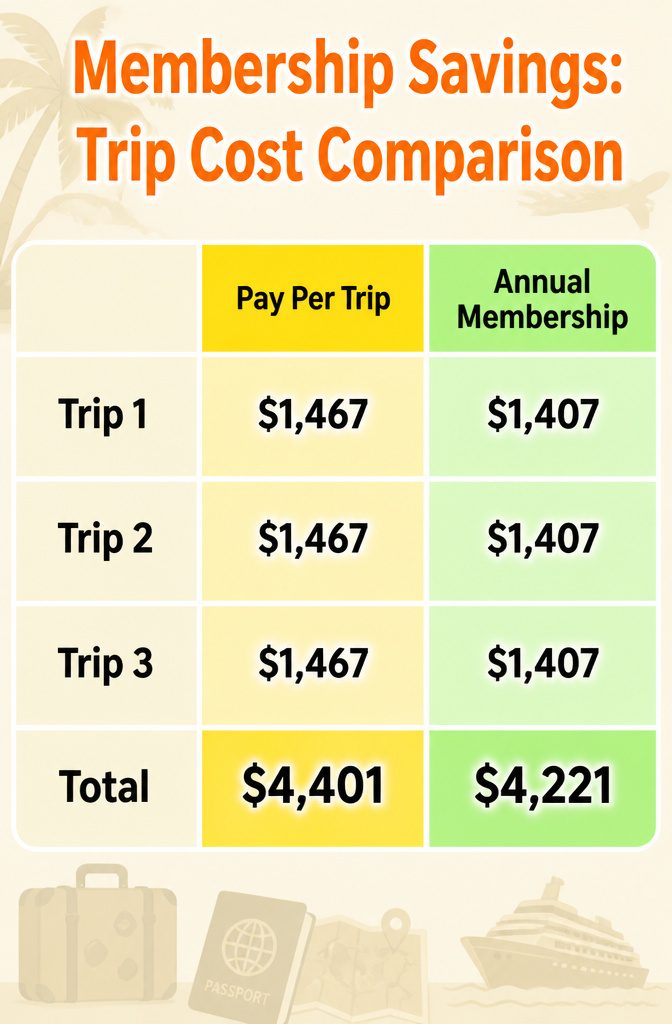
The math on membership only works if you travel enough to clear the fee. Take three trips at that $1,467 starting price and the membership savings start to show.
| Pay Per Trip | Annual Membership | |
|---|---|---|
| Trip 1 | $1,467 | $1,407 |
| Trip 2 | $1,467 | $1,407 |
| Trip 3 | $1,467 | $1,407 |
| Total | $4,401 | $4,221 |
Three trips gets you $180 back against whatever the membership costs. That $60 average savings per booking comes from coupon-style discounts the service runs; whether it applies to your exact trip depends on timing and destination.
The membership itself may run $100–200 for the year, which means the break-even sits somewhere between two and four trips for most travelers.
If you are booking once a year, skip it. If you are the kind of traveler running multiple trips inside a three-month window, the membership pays for itself and the savings stack from there.
When Trip Protection Pays Off
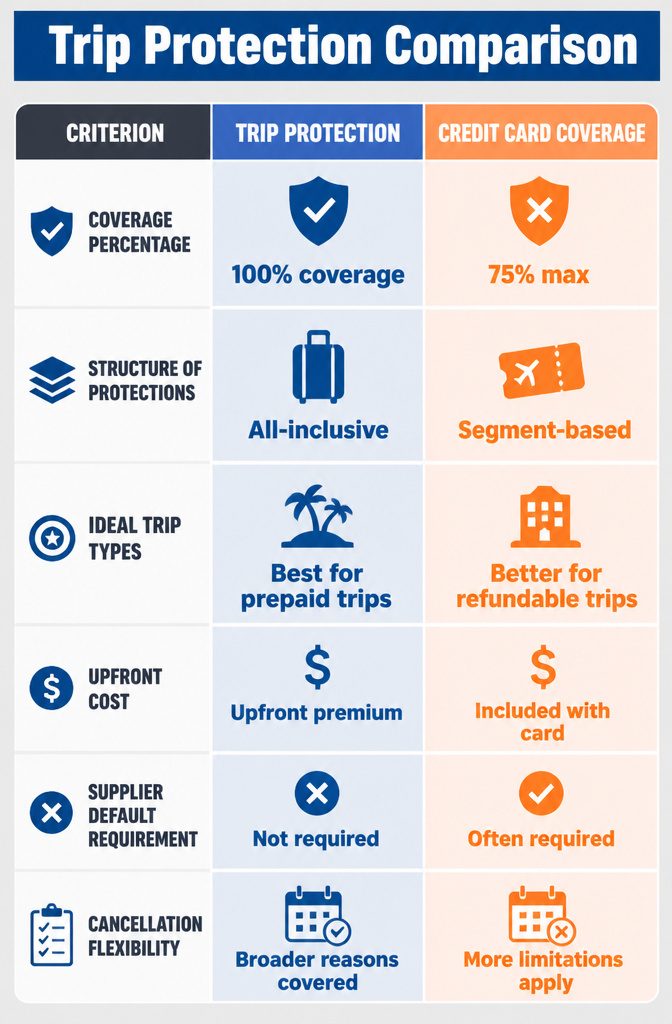
Trip protection earns its keep on bookings where 100% cancellation coverage applies, the kind standard credit card protection rarely matches.
Most cards cap reimbursement at 75% or require the supplier to default first, which leaves you exposed if you cancel for covered medical reasons or a qualifying family emergency.
The gap shows up clearest on prepaid, non-refundable packages running several thousand dollars.
Credit card coverage typically treats these as individual segments, each with its own deductible and exclusions, while a dedicated trip protection plan treats the whole itinerary as one insured sum.
Where credit cards already handle the risk adequately: short domestic trips with fully refundable hotel rates, or flights booked with points that redeposit for a modest fee. Adding a separate protection plan there layers cost without adding recovery.
You pay an upfront premium against the size of what you might lose. A $4,000 island-hopping package with strict supplier terms justifies the extra spend; a $400 mainland weekend with a 24-hour cancellation window does not.
I buy protection when the cancellation penalty exceeds what I could absorb without altering the next trip I have planned.
Frequently Asked Questions
What types of travel services does Trip To Go provide?
Trip To Go covers flights, hotels, tours, and transfers in a single booking flow. The platform connects directly to provider inventory rather than pulling through middle layers, which keeps bundled pricing from stacking markups at each step.
Transfers are especially useful for island destinations where that last-mile connection often decides whether the trip actually works.
How does Trip To Go ensure customer satisfaction?
The service staffs a 24/7 support team that travelers rate highly for responsiveness and professionalism, and it maintains direct relationships with airlines, hotels, and tour operators.
Those direct connections let agents sometimes hold rooms or secure seats that a generalist calling a public line cannot.
The same structure has limits when a local operator never received a customization or confirmation, so satisfaction depends partly on how complex your itinerary is.
What are the pricing structures for using Trip To Go?
Most trips start at $1,467 with active coupons averaging $60 off, and the headline price includes mandatory charges rather than unrolling them at checkout as resort fees or add-ons.
An annual membership runs about $60 and unlocks the full itinerary catalog, with the break-even point landing around the second trip. Pay per trip runs $40–$50 each time, so two or more trips a year favors membership.
Is Trip to Go a reputable company?
Reviewers praise the 24/7 support team’s professionalism and the quality of local guides and accommodations on trips that run smoothly.
Complaints cluster around breakdowns the support desk cannot fix, such as tour operators that never confirmed or customizations that did not reach the ground team.
For simple single-destination packages the satisfied track is typical; for multi-stop itineraries with mixed guided and independent legs, the risk of gaps between platform promise and local execution runs higher.





